
Density Index / Relative Density / Degree of Density
It is used to represent the relative degree of compactness of natural cohesion-less soil in absolute terms, unlike void ratio & dry unit weight. It is represented as ‘ID’.
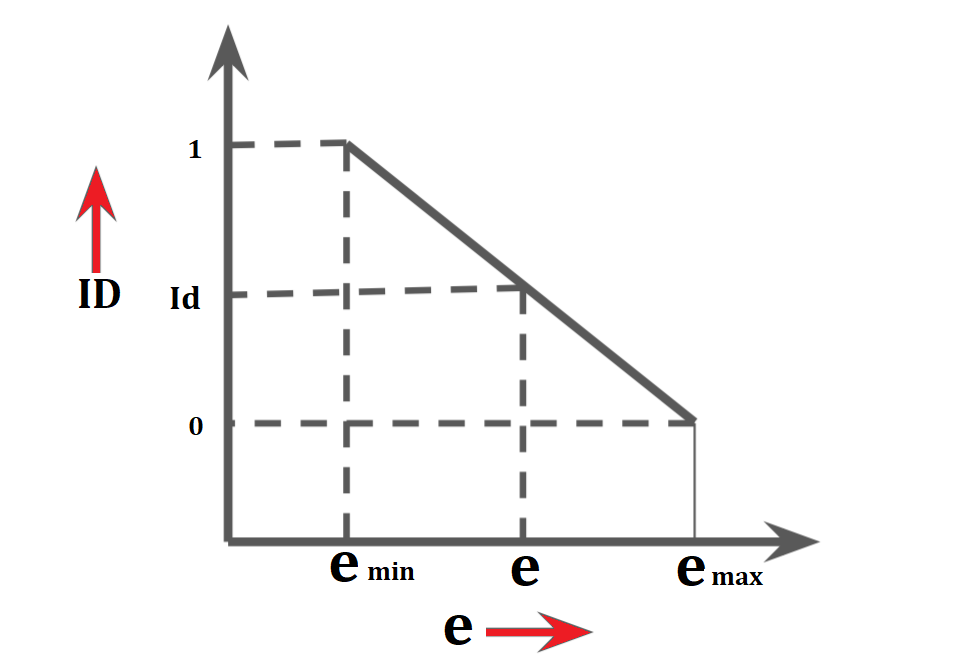
\(I_{D}=\frac{e_{\max }-e}{e_{\max }-e_{\min }} \times 100\)It is the Unit less.
It is defined as the ratio of the difference between the void ratio of soil in the loosest state & natural state to the difference in the void ratio of soil in the loosest state & densest state.
\(e_{\max }=\text { void ratio of soil in loosest state }\) \(e_{\min }=\text { void ratio of soil in densest state }\)e = void ratio of soil in a natural state.
If soil naturally is in the loosest state.
\(\mathrm{e}=e_{\max } \Rightarrow \mathrm{ID}=\mathrm{O} \%\)If soil naturally is in the densest state.
\(\mathrm{e}=e_{\min } \Rightarrow \mathrm{ID}=\mathrm{100} \%\)0%≤ID≤100%.
⇒ e ∝ (1/γd)
\(\mathbf{I} \mathbf{d}=\frac{\frac{1}{\gamma_{d \min }}-\frac{1}{\gamma_{d}}}{\frac{1}{\gamma_{d m i n}}-\frac{1}{\gamma_{d m a x}}} \times 100\)
Degree of Denseness According to Degree of Density
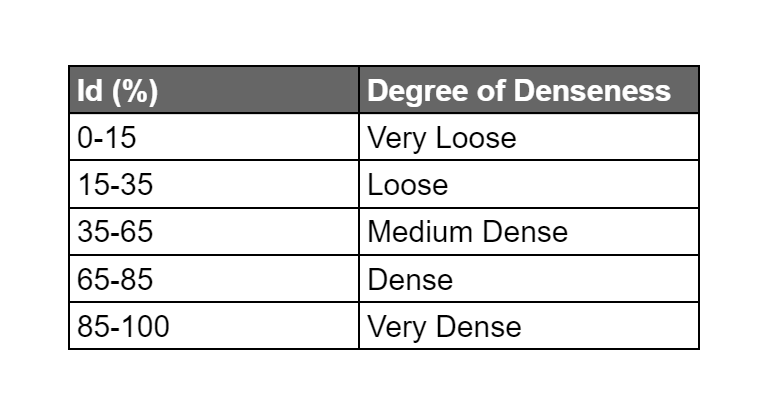
- Id is not used for the analysis of cohesive soil(silt, clay) as there are large uncertainties involved in finding the void ratio of cohesive soil in its loosest state in the laboratory.
- Two sand deposits having the same shape & size can exhibit different properties if they have different Density Index.
- Sand having Density Index is more compact, dense, stable, less compressible, and has higher shear strength.
- With Increase Density Index, increase in compact, dense, shear strength, & decrease change in volume.(Id↑ ∝ Dense↑ ∝ Compact↑ ∝ shear strength↑ ∝ change in Volume ↓)
If we have two soil with density index ID1, ID2. and ID1 > ID2. then soil 1 is used for the foundation.
| Subject | Soil Mechanics |
| Unit | Soil Formation & Properties of Soil |
| Topic | Density Index |
| Next Topic | Relative Compaction |
| Previous Topic | Specific Gravity |