
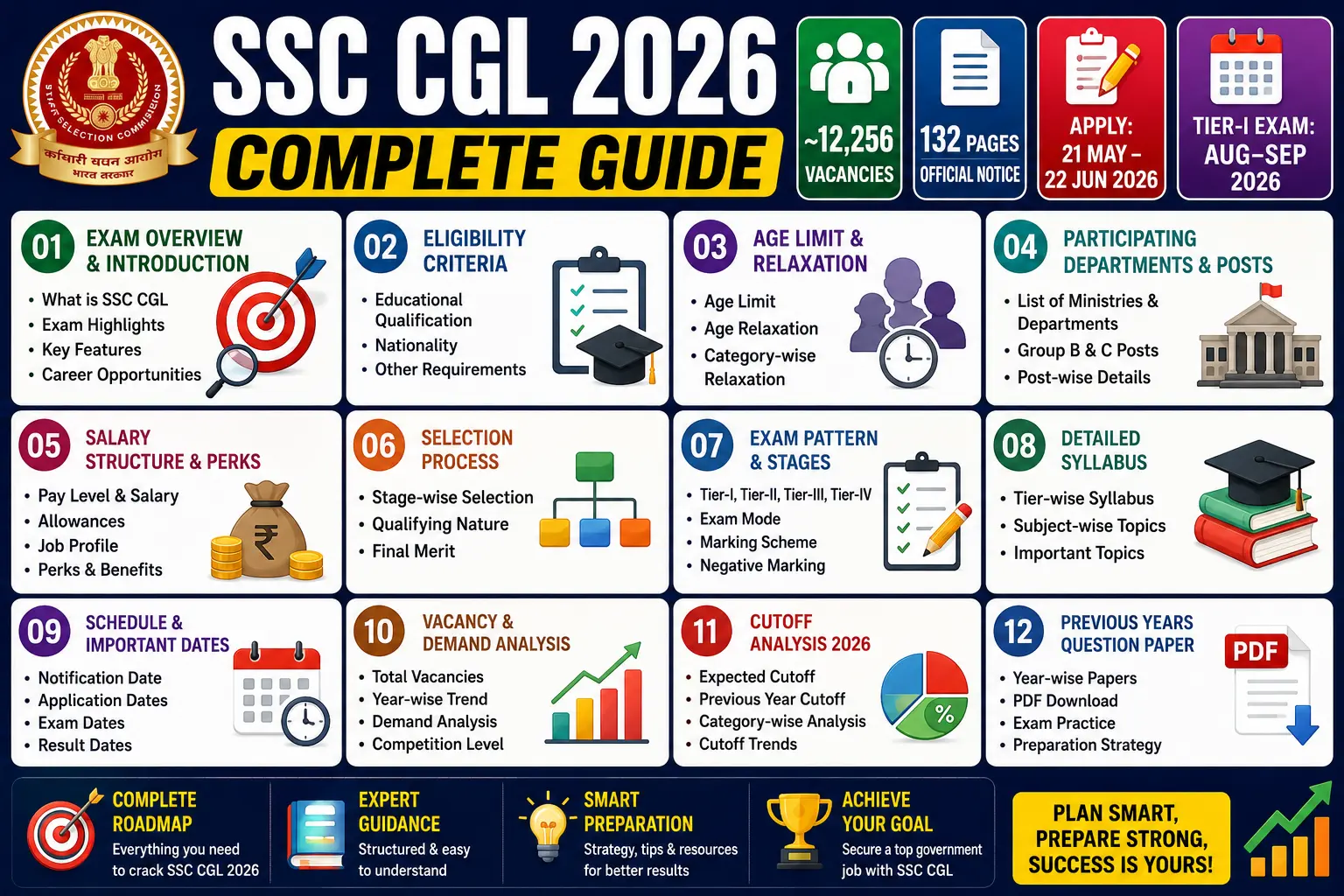
SSC CGL Exam Overview & Introduction 2026
Staff Selection Commission Combined Graduate Level Examination 2026 (SSC CGL 2026) is most popular competitive government exams for graduate students in India. The Staff Selection Commission (SSC) of the Government of India conducts the examination for recruitment to various Group ‘B’ and Group ‘C’ posts in different Ministries, Departments and Organizations of the Central Government. SSC CGL is conducted once a year in a computer-based test (CBT) mode. SSC CGL is regarded as one of the best career opportunities for graduates looking for a stable government job.
The SSC CGL recruitment posts like Income Tax Inspector, GST Inspector, Assistant Section Officer (ASO), CBI Sub-Inspector, Auditor, Accountant, and Tax Assistant. The examination is very much in demand because of its high salary structure, job security, promotion opportunities, work-life balance and other government benefits.
Most of the posts in SSC CGL are classified as Group ‘B’ and Group ‘C’ of the Central Government. The salary structure is based on post and pay level and ranges generally between Pay Level-4 and Pay Level-8 of the 7th Central Pay Commission (CPC). The approximate salary is ₹25,500 to ₹1,42,400 per month. Besides this, the post is also entitled to various Government allowances like Dearness Allowance (DA), House Rent Allowance (HRA), Travel Allowance (TA), medical benefits, pension benefits and other facilities as provided to the Central Government employees.
Approximately 30-40 lakh candidates appear for the SSC CGL exam annually, making it one of the biggest graduate-level competitive exams in the country. The competition is still very big because the number of applicants is huge and the vacancies are limited. In recent times, SSC CGL 2022 had more than 37,000 vacancies, SSC CGL 2023 had around 8,000 vacancies, SSC CGL 2024 had announced more than 17,000 vacancies and SSC CGL 2025 had almost 18,000 vacancies. SSC CGL 2026 Official Notification Released on 21st May 2026 on their official website.
The SSC CGL recruitment process generally includes the stages of Tier 1, Tier 2, skill test and document verification. The exam tests the candidates on subjects like Quantitative Aptitude, General Intelligence & Reasoning, English Language, General Awareness, Computer Knowledge and Data Entry Skills.
SSC CGL Eligibility Criteria 2026: Qualification, Age Limit & More
Before applying the SSC CGL 2026, students should check and properly read the eligibility conditions of SSC CGL. Because every year, thousands of applications are rejected by SSC due to not fulfilling the basic SSC CGL eligibility conditions. So, please read the requirements carefully before applying.
SSC CGL eligibility criteria are mainly divided into 4 parts:
- Nationality / Citizenship
- Educational Qualification (Post-wise requirement applicable)
- Age Limit & Age Relaxation
- Physical Standards (for selected posts only)
Nationality / Citizenship
A candidate shall be one or more of the following:
- An Indian citizen, or
- A citizen of Nepal or Bhutan, or
- A Person of Indian Origin (PIO) who has migrated from the following countries with the intention of settling permanently in India: Pakistan Burma (Myanmar) Sri Lanka East African countries such as Kenya, Uganda, Tanzania, Zambia, Malawi, Zaire (Congo), Ethiopia Vietnam
Additional Requirement, the candidate must:
- Have the intention to settle permanently in India
- Candidates belonging to Nepal, Bhutan or PIO categories should have Certificate of Eligibility from Government of India (if applicable).
- Such candidates may be permitted to appear in the examination provisionally but their final appointment shall be subject to the issuance of the eligibility certificate.
Specific terms and conditions
- Only male candidates are eligible for posts in Border Roads Organisation (BRO).
Educational Qualification (as on 01.08.2026)
If you are applying for SSC CGL 2026, then the student must fulfill the required educational qualifications on or before 01 August 2026. Final year graduation students are also eligible to apply, but they have to declare the result and obtain the required qualification on or before the cutoff date, otherwise they will not be considered eligible.
| Post Category | Essential Qualification | Desirable Qualification |
|---|---|---|
| Assistant Audit Officer (AAO) – Central Cadre | Bachelor’s Degree from a recognized University or Institute | Chartered Accountant (CA), Cost & Management Accountant (CMA), Company Secretary (CS), M.Com, MBS, MBA (Finance), Master’s in Business Economics (MBE) |
| Assistant Audit Officer (AAO) – State Cadre | Bachelor’s Degree from a recognized University or Institute + Proficiency in Regional/Official Language of the concerned State (Reading, Writing, Speaking, Understanding) | Chartered Accountant (CA), Cost & Management Accountant (CMA), Company Secretary (CS), M.Com, MBS, MBA (Finance), MBE |
| Assistant Accounts Officer (AAO) – State Cadre | Bachelor’s Degree from a recognized University or Institute + Proficiency in Regional/Official Language of the concerned State (with certificate of proficiency at Secondary/Matric level from a recognized Board) | Chartered Accountant (CA), Cost & Management Accountant (CMA), Company Secretary (CS), M.Com, MBS, MBA (Finance), MBE |
| Junior Statistical Officer (JSO) | Either: 1. Bachelor’s Degree in any discipline + 60% marks in Mathematics at 12th level OR 2. Bachelor’s Degree with Statistics as one of the subjects | — |
| Statistical Investigator Grade-II | Bachelor’s Degree in any of the following subjects: Statistics, Mathematics, Economics, Demography, Population Studies, Operational Research, Information Technology, Computer Science, Computer Engineering, Computer Technology, Computer Applications, Data Science, Artificial Intelligence | — |
| All Other Posts | Bachelor’s Degree from a recognized University or equivalent | — |
Probation Requirement: If any candidates are selected for Assistant Audit Officer (AAO) posts then, they must pass the Subordinate Audit/Accounts Service Examination during the probation period for confirmation and regular appointment.
Important Note: The students who are in their final year of graduation are also eligible to apply. However, they are eligible having the required educational qualification on or before 01 August 2026.
Open & Distance Learning (ODL) Degrees: If you have graduation/diplomas degree through Open and Distance Learning (ODL) mode then it is valid only if approved by the Distance Education Bureau, UGC or awarded by a recognized University/Institution.
Important Note: Some of the professional and technical courses are not allowed to be offered in distance/online mode as per UGC Open and Distance Learning (ODL) Regulations, 2017. They include:
- Engineering
- Medicine
- Dental
- Nursing
- Pharmacy
- Architecture
- Physiotherapy
Exception: However, a Supreme Court judgment dated 11 March 2019 has held that B.Tech degrees/diplomas awarded by IGNOU to students admitted till the academic year 2009-10 are valid.
Document Verification Requirement: At the time of document verification, it is mandatory to present the original documents by student, including:
- Graduation Degree Certificate (or Provisional Certificate)
- Mark Sheets of all semesters per years
Result & Eligibility Criteria:A candidate will be considered eligible only if there is proper documentary proof that:
- The result has been declared on or before the cut-off date
- The candidate has been officially declared passed
Equivalent Qualification: Candidates claiming an equivalent qualification must produce an Equivalence Certificate issued by the competent authority during document verification. Final acceptance of equivalence will be decided by the concerned User Department/Appointing Authority.
Age Limit & Age Relaxation
SSC CGL Age Limit and Age Relaxation for 2026 is different for each post and category of the candidate. The complete details of age criteria, post wise age limits and category wise relaxations will be discussed in the next section. For detailed information, please click here: button below.
Physical Standards (Post-specific)
Physical standards are applicable only for some specific posts under SSC CGL. Please note that most of the SSC CGL posts do NOT require any physical test. These standards are applicable only after final selection and are conducted by the respective user departments.
Here are the complete physical standards for different SSC CGL posts. Please check all sections.
Inspector (Central Excise / Examiner / Preventive Officer) & Inspector & Sub-Inspector (Central Bureau of Narcotics- CBN)
| Physical Standard | Male Candidates | Female Candidates |
|---|---|---|
| Height | 157.5 cm Relaxable by 5 cm for Garhwalis, Assamese, Gorkhas and ST candidates. | 152 cm Relaxable by 2.5 cm for Gorkhas, Garhwalis, Assamese and ST candidates. |
| Chest | 81 cm (Fully Expanded) Minimum Expansion: 5 cm | Not Applicable |
| Weight | Not Prescribed | 48 kg Relaxable by 2 kg for Gorkhas, Garhwalis, Assamese and ST candidates. |
| Vision | Not Prescribed | Not Prescribed |
| Physical Test (Walk) | 1600 metres in 15 minutes | 1 kilometre in 20 minutes |
| Physical Test (Cycle) | 8 kilometres in 30 minutes | 3 kilometres in 25 minutes |
Sub-Inspector — CBI (Central Bureau of Investigation)
| Physical Standard | Male Candidates | Female Candidates |
|---|---|---|
| Height | 165 cm Relaxable by 5 cm for Hillsmen & Tribals. | 150 cm Relaxable by 5 cm for Hillsmen & Tribals. |
| Chest | 76 cm with expansion | Not Applicable |
| Vision (Distant) | 6/6 & 6/9 | |
| Vision (Near) | 0.6 & 0.8 | |
Sub-Inspector — NIA (National Investigation Agency)
| Physical Standard | Male Candidates | Female Candidates |
|---|---|---|
| Height | 170 cm Relaxable by 5 cm for Hillsmen & Tribals. | 150 cm Relaxable by 5 cm for Hillsmen & Tribals. |
| Chest | 76 cm with expansion | Not Applicable |
| Vision (Distant) | 6/6 & 6/9 | |
| Vision (Near) | 0.6 & 0.8 | |
Sub-Inspector / JIO(Junior Intelligence Officer) — NCB, MHA (Narcotics Control Bureau)
| Physical Standard | Male Candidates | Female Candidates |
|---|---|---|
| Height | 165 cm Relaxable by 5 cm for NE States, Ladakh, J&K, A&N, Lakshadweep, HP Tribal. | 152 cm Relaxable by 5 cm for NE States, Ladakh, J&K, A&N, Lakshadweep, HP Tribal. |
| Chest | 76 cm (unexpanded) with 5 cm expansion | Not Applicable |
| Vision (Distant) | 6/6 & 6/9 | |
| Vision (Near) | 0.6 & 0.8 | |
BRO Posts (PET, Physical & Medical Standards)
Candidates selected for Border Roads Organization (BRO/GREF) posts through SSC CGL must qualify all three schedules prescribed by BRO:
- Schedule-I (Physical Efficiency Test)
- Schedule-II (Physical Standards)
- Schedule-III (Medical Standards)
These tests are conducted after the final SSC selection at GREF Centre, Pune or designated Recruitment Centres.
| Physical Standard | Details |
|---|---|
| Physical Efficiency Test (PET) | One Mile Run (1.6 km) – Mandatory to Qualify within 10 Minutes. Conducted at GREF Centre, Pune or designated Recruitment Centre before Medical Examination. |
| Physical Standards | Western Himalayan: Height 158 cm, Chest 75+5 cm expansion, Weight 47.5 kg Eastern Himalayan: Height 152 cm, Chest 75+5 cm expansion, Weight 47.5 kg West Plain: Height 162.5 cm, Chest 76+5 cm expansion, Weight 50 kg Eastern Plain: Height 157 cm, Chest 75+5 cm expansion, Weight 50 kg Central: Height 157 cm, Chest 75+5 cm expansion, Weight 50 kg Southern: Height 157 cm, Chest 75+5 cm expansion, Weight 50 kg Gorkhas (Indian Domicile): Height 152 cm, Chest 75+5 cm expansion, Weight 47.5 kg |
| Relaxation in PST | Sons of Serving / Ex-GREF Personnel: Height −2 cm, Chest −1 cm, Weight −2 kg. DD Cases (Own/Adopted Son): Height −2 cm, Chest −1 cm, Weight −2 kg. |
| Vision (Medical Standards) | Not less than 6/12 in each eye OR Right Eye 6/6 and Left Eye 6/24. Corrective spectacles permitted. Unaided vision not below 6/60 in each eye. |
| Permanent Rejection | BMI below 18, Colour Blindness, Squint/Nystagmus, Severe Knock Knee, Bow Legs, Flat Feet, Deafness, Pronounced Stammering, Chronic Lung Disease, Hypertension above 140/95 mm Hg, Major Physical Deformities, Prohibited Tattoos and other serious medical conditions affecting work efficiency. |
| Temporary Rejection | Conjunctivitis, Pterygium, DNS, Hydrocele, Hernia, Varicocele, Dental Defects, Anaemia, Varicose Veins, Skin Diseases, BMI above 30 and other treatable medical conditions. |
| Minor Defects May Be Accepted | Mild Flat Feet, Mild Knock Knee, Mild Bow Legs, Slight Stammering, Mild Hyperhidrosis, Minor Varicocele, Healed Tympanoplasty, Corrected DNS and other minor defects not affecting work efficiency. |
| Tattoo Policy | Permanent tattoos permitted only on the inner side of forearms and back of hands. Tattoos on any other body part may lead to disqualification. |
| Service Liability | All India Transfer Liability. Initial training at GREF Centre, Dighi Camp, Pune. Certain provisions of the Army Act, 1950 are applicable. |
Note: Physical Efficiency Test, Physical Standards Verification and Medical Examination for BRO posts are conducted by the User Department after final selection by SSC. Candidates failing any prescribed requirement for the allotted BRO post will not be considered for appointment to any other SSC CGL post. Therefore, candidates should opt for BRO posts only if they satisfy all physical and medical standards. For more information, read the SSC CGL 2026 Notification.
Critical Note:The User Department conducts physical/medical tests AFTER final selection by SSC. If a candidate fails the physical or medical test for the allotted post, their candidature will NOT be reconsidered for any other post. Choose your post preference carefully.
SSC CGL 2026: Age Limit & Relaxation
There are 40 posts in the SSC CGL exam from Pay Level 4 to Pay Level 8 under the Group B and Group C posts. Each post has its own specific age requirement and Pay Level according to departmental rules and the nature of the job responsibilities.
For the convenience of candidates, all 40 posts are given below in order of Group, Pay Level and age limit applicable. In this section aspirants will get a clear idea about the eligibility criteria of each post in a simple and structured way before applying.
Group B (Gazetted) — Pay Level 8
| S. No. | Name of Post | Age Limit |
|---|---|---|
| 1 | Assistant Audit Officer (Central Cadre) | 18–30 years |
| 2 | Assistant Audit Officer (State Cadre) | 18–30 years |
| 3 | Assistant Accounts Officer (State Cadre) | 18–30 years |
Group B — Pay Level 7
| S. No. | Name of Post | Age Limit |
|---|---|---|
| 4 | Assistant Section Officer (CSS) | 20–30 years |
| 5 | Assistant Section Officer (Intelligence Bureau) | 18–30 years |
| 6 | Assistant Section Officer (Railways) | 20–30 years |
| 7 | Assistant Section Officer (External Affairs) | 20–30 years |
| 8 | Assistant Section Officer (AFHQ) | 20–30 years |
| 9 | Assistant Section Officer (MeitY) | 18–30 years |
| 10 | Assistant / Assistant Section Officer (Other Ministries) | 18–30 years |
| 11 | Inspector of Income Tax | 18–30 years |
| 12 | Inspector (Central Excise) | 18–30 years |
| 13 | Inspector (Preventive Officer) | 18–30 years |
| 14 | Inspector (Examiner) | 18–30 years |
| 15 | Assistant Enforcement Officer | 18–30 years |
| 16 | Sub Inspector (CBI) | 20–30 years |
| 17 | Inspector Posts | 18–30 years |
| 18 | Inspector (Central Bureau of Narcotics) | 18–30 years |
Group B — Pay Level 6
| S. No. | Name of Post | Age Limit |
|---|---|---|
| 19 | Assistant / Assistant Section Officer | 18–30 years |
| 20 | Executive Assistant | 18–30 years |
| 21 | Research Assistant | 18–30 years |
| 22 | Divisional Accountant | 18–30 years |
| 23 | Sub Inspector (NIA) | 18–30 years |
| 24 | Sub-Inspector / Junior Intelligence Officer | 18–30 years |
| 25 | Junior Statistical Officer (JSO) | 18–32 years |
| 26 | Statistical Investigator Grade-II | 18–30 years |
| 27 | Office Superintendent | 18–30 years |
| 28 | Section Head | 18–30 years |
Group C — Pay Level 5
| S. No. | Name of Post | Age Limit |
|---|---|---|
| 29 | Auditor (C&AG) | 18–27 years |
| 30 | Auditor (CGDA) | 18–27 years |
| 31 | Auditor (Other Departments) | 18–27 years |
| 32 | Accountant (C&AG) | 18–27 years |
| 33 | Accountant (CGA) | 18–27 years |
| 34 | Accountant / Junior Accountant | 18–27 years |
Group C — Pay Level 4
| S. No. | Name of Post | Age Limit |
|---|---|---|
| 35 | Postal Assistant / Sorting Assistant | 18–27 years |
| 36 | Senior Secretariat Assistant / UDC | 18–27 years |
| 37 | Senior Administrative Assistant | 18–27 years |
| 38 | Tax Assistant (CBDT) | 18–27 years |
| 39 | Tax Assistant (CBIC) | 18–27 years |
| 40 | Sub-Inspector (Central Bureau of Narcotics) | 18–27 years |
Quick Birth Date Reference (as on 01.08.2026):
To help the user avoid calculation, we provide a “Born Not Earlier Than” and “Born Not Later Than” dates to see candidates fall in this date range. The date of birth should strictly be within the prescribed range as per SSC eligibility rules to ensure that they satisfy the age criteria.
| Age Limit | Born Not Earlier Than | Born Not Later Than |
|---|---|---|
| 18–27 years | 02-08-1999 | 01-08-2008 |
| 20–30 years | 02-08-1996 | 01-08-2006 |
| 18–30 years | 02-08-1996 | 01-08-2008 |
| 18–32 years | 02-08-1994 | 01-08-2008 |
Permissible Age Relaxation in Upper Age Limit:
Candidates should check their age relaxation according to their category (SC/ST, OBC, PwBD, Ex-Servicemen etc.) and ensure that the date of birth falls within the prescribed eligibility limit of SSC after applying the relaxation rules.
| Code | Category | Relaxation |
|---|---|---|
| 01 | SC / ST | 5 years |
| 02 | OBC | 3 years |
| 03 | PwBD (General / UR) | 10 years |
| 04 | PwBD + OBC | 13 years |
| 05 | PwBD + SC / ST | 15 years |
| 06 | Ex-Servicemen (ESM) | 3 years after deduction of military service rendered |
| 08 | Defence Personnel disabled in operations | 3 years |
| 09 | Defence Personnel disabled in operations – SC / ST | 8 years |
| 10 | Central Govt. Civilian Employees (≥3 yrs continuous service) – Group C | Up to 40 years of age |
| 11 | Central Govt. Civilian Employees (≥3 yrs continuous service) – SC / ST – Group C | Up to 45 years of age |
| 12 | Widows / Divorced Women (not remarried) | Up to 35 years of age |
| 13 | Widows / Divorced Women (not remarried) – SC / ST | Up to 40 years of age |
- Your Date of birth on the 10th/12th certificate will be considered as the final proof of your age.
- No change in DOB will be allowed after submitting the form.
- Check your DOB carefully before final submission of the SSC CGL application.
Participating Departments & Posts
The SSC CGL 2026 recruits for different Group “B” and Group “C” posts in the Central Government departments. Posts are classified according to various Pay Levels with Department and age limit for better understanding.
Pay Level-8 (₹47,600 – ₹1,51,100)
| S.No | Name of Post | Ministry / Department / Office | Classification | Age Limit |
|---|---|---|---|---|
| 1 | Assistant Audit Officer (Central Cadre) | Indian Audit & Accounts Department under C&AG | Group “B” Gazetted (Non-Ministerial) | 18–30 years |
| 2 | Assistant Audit Officer (State Cadre) | Indian Audit & Accounts Department under C&AG | Group “B” Gazetted (Non-Ministerial) | 18–30 years |
| 3 | Assistant Accounts Officer (State Cadre) | Indian Audit & Accounts Department under C&AG | Group “B” Gazetted (Non-Ministerial) | 18–30 years |
Pay Level-7 (₹44,900 – ₹1,42,400)
| S.No | Name of Post | Ministry / Department / Office | Classification | Age Limit |
|---|---|---|---|---|
| 4 | Assistant Section Officer | Central Secretariat Service | Group “B” | 20–30 years |
| 5 | Assistant Section Officer | Intelligence Bureau | Group “B” | 18–30 years |
| 6 | Assistant Section Officer | Ministry of Railways | Group “B” | 20–30 years |
| 7 | Assistant Section Officer | Ministry of External Affairs | Group “B” | 20–30 years |
| 8 | Assistant Section Officer | AFHQ (Armed Forces Headquarters) | Group “B” | 20–30 years |
| 9 | Assistant Section Officer | Ministry of Electronics & IT | Group “B” | 18–30 years |
| 10 | Assistant / ASO | Various Ministries / Departments | Group “B” | 18–30 years |
| 11 | Inspector of Income Tax | CBDT (Central Board of Direct Taxes) | Group “B” | 18–30 years |
| 12 | Inspector (Central Excise) | CBIC (Central Board of Indirect Taxes and Customs) | Group “B” | 18–30 years |
| 13 | Inspector (Preventive Officer) | CBIC (Central Board of Indirect Taxes and Customs) | Group “B” | 18–30 years |
| 14 | Inspector (Examiner) | CBIC (Central Board of Indirect Taxes and Customs) | Group “B” | 18–30 years |
| 15 | Assistant Enforcement Officer | Directorate of Enforcement (ED) | Group “B” | 18–30 years |
| 16 | Sub Inspector | Central Bureau of Investigation (CBI) | Group “B” | 20–30 years |
| 17 | Sub Inspector | National Investigation Agency (NIA) | Group “B” | 20–30 years |
| 18 | Inspector Posts | Department of Posts | Group “B” | 18–30 years |
| 19 | Inspector | Central Bureau of Narcotics (CBN) | Group “B” | 18–30 years |
Pay Level-6 (₹35,400 – ₹1,12,400)
| S.No | Name of Post | Ministry / Department / Office | Classification | Age Limit |
|---|---|---|---|---|
| 20 | Executive Assistant | CBIC (Central Board of Indirect Taxes and Customs) | Group “B” | 18–30 years |
| 21 | Research Assistant | NHRC ( National Human Rights Commission) | Group “B” | 18–30 years |
| 22 | Divisional Accountant | C&AG Offices | Group “B” | 18–30 years |
| 23 | Sub Inspector | NIA (NIA National Investigation Agency) | Group “B” | 18–30 years |
| 24 | Sub Inspector / JIO | NCB (MHA) | Group “B” | 18–30 years |
| 25 | Junior Statistical Officer | MoSPI (Ministry of Statistics and Programme Implementation) | Group “B” | 18–32 years |
| 26 | Statistical Investigator Grade-II | MHA (Ministry of Home Affairs) | Group “B” | 18–30 years |
| 27 | Office Superintendent | CBDT (Central Board of Direct Taxes) | Group “B” | 18–30 years |
| 28 | Section Head | DGFT | Group “B” | 18–30 years |
Pay Level-5 (₹29,200 – ₹92,300)
| S.No | Name of Post | Department | Classification | Age Limit |
|---|---|---|---|---|
| 29 | Auditor | C&AG / CGDA (Controller General of Defence Accounts) | Group “C” | 18–27 years |
| 30 | Auditor | Other Ministries | Group “C” | 18–27 years |
| 31 | Accountant | C&AG (Comptroller and Auditor General of India (Indian Audit & Accounts Department)) | Group “C” | 18–27 years |
| 32 | Accountant | CGA ( Controller General of Accounts) | Group “C” | 18–27 years |
| 33 | Junior Accountant | Other Ministries | Group “C” | 18–27 years |
Pay Level-4 (₹25,500 – ₹81,100)
| S.No | Name of Post | Department | Classification | Age Limit |
|---|---|---|---|---|
| 34 | Postal Assistant / Sorting Assistant | Department of Posts | Group “C” | 18–27 years |
| 35 | Senior Secretariat Assistant / UDC | Central Government Offices | Group “C” | 18–27 years |
| 36 | Senior Administrative Assistant | MES ( Military Engineer Services) | Group “C” | 18–27 years |
| 37 | Tax Assistant | CBDT ( Central Board of Direct Taxes) | Group “C” | 18–27 years |
| 38 | Tax Assistant | CBIC ( Central Board of Indirect Taxes and Customs) | Group “C” | 18–27 years |
| 39 | Sub Inspector | CBN ( Central Bureau of Narcotics) | Group “C” | 18–27 years |
| 40 | Account Assistant | Central Government Departments | Group “C” | 18–27 years |
SSC CGL Salary Per Month
SSC CGL (Combined Graduate Level) salary is not a fixed single amount. It depends on the post, pay level, city (X/Y/Z), and allowances. But I’ll break it down in a very clear “per month in-hand” way. The gross salary is calculated as: Basic Pay + DA + HRA + TA + Other Allowances.
SSC CGL posts fall under these Pay Levels:| Pay Level | Basic Pay Scale (₹) | Grade Pay | Posts Covered | Group |
|---|---|---|---|---|
| Level 8 | ₹47,600 – ₹1,51,100 | ₹4,800 | Assistant Audit Officer (Central Cadre) | Assistant Audit Officer (State Cadre) | Assistant Accounts Officer (State Cadre)Under C&AG | Group B (Gazetted) |
| Level 7 | ₹44,900 – ₹1,42,400 | ₹4,600 | ASO – CSS | ASO – Intelligence Bureau | ASO – Railways | ASO – MEA | ASO – AFHQ | ASO – MeitY | Assistant / ASO – Other Ministries | Inspector of Income Tax (CBDT) | Inspector (Central Excise) (CBIC) | Inspector (Preventive Officer) (CBIC) | Inspector (Examiner) (CBIC) | Assistant Enforcement Officer (ED) | Sub-Inspector (CBI) | Inspector Posts | Inspector – CBN (Ministry of Finance) | Group B |
| Level 6 | ₹35,400 – ₹1,12,400 | ₹4,200 | Executive Assistant (CBIC) | Research Assistant (NHRC) | Divisional Accountant (C&AG) | Sub-Inspector (NIA) | Sub-Inspector / Junior Intelligence Officer (NCB, MHA) | Junior Statistical Officer (JSO) (MoSPI) | Statistical Investigator Grade-II (MHA) | Office Superintendent (CBDT) | Section Head (DGFT) | Group B |
| Level 5 | ₹29,200 – ₹92,300 | ₹2,800 | Auditor (C&AG) | Auditor (CGDA) | Auditor (Other Departments) | Accountant (C&AG) | Accountant (CGA) | Junior Accountant (Other Ministries) | Group C |
| Level 4 | ₹25,500 – ₹81,100 | ₹2,400 | Postal Assistant / Sorting Assistant (Department of Posts) | Senior Secretariat Assistant / UDC (Central Government Offices) | Senior Administrative Assistant (MES) | Tax Assistant (CBDT) | Tax Assistant (CBIC) | Sub-Inspector (CBN) | Group C |
- Dearness Allowance (DA): Currently, Dearness Allowance (DA) of SSC CGL employees is 60% of the basic pay. This rate, revised from 58%, is revised periodically twice a year (in January and July) to adjust for the impact of inflation.
- House Rent Allowance (HRA): 27% (X cities), 18% (Y cities), 9% (Z cities) of Basic Pay — depending on place of posting.
- Transport Allowance (TA): ₹3,600–₹7,200/month + DA.
- Medical Benefits: Central Government Health Scheme (CGHS) for self and family.
- Leave Travel Concession (LTC): Fully paid travel to home town or all-India travel once in 4 years.
- Pension (NPS): SSC CGL Employees covered under National Pension System (NPS).
- General Provident Fund (GPF): Applicable to pre-2004 recruits; NPS for others.
- Children Education Allowance: Up to 2 children.
Pension (NPS): National Pension System (NPS) with government contribution of 14% of Basic Pay + DA. GPF (General Provident Fund) is applicable for employees appointed prior to 2004; NPS for others. Children Education Allowance: Maximum 2 children.
SSC CGL Post Wise In-Hand Salary After Joining: Salary may vary depending on City Category (X, Y, Z City), HRA, deductions, and department allowances. The figures below are approximate monthly in-hand salaries of different posts after joining.
| Post Name | Pay Level | Expected First In-Hand Salary |
|---|---|---|
| Assistant Audit Officer (AAO) | Level 8 | ₹78,000 – ₹90,000 |
| Assistant Accounts Officer (AAO) | Level 8 | ₹78,000 – ₹90,000 |
| Assistant Section Officer (CSS) | Level 7 | ₹68,000 – ₹80,000 |
| Assistant Section Officer (MEA) | Level 7 | ₹75,000 – ₹90,000 |
| Assistant Section Officer (Railways / AFHQ / IB) | Level 7 | ₹65,000 – ₹78,000 |
| Inspector of Income Tax | Level 7 | ₹65,000 – ₹78,000 |
| Inspector (Central Excise) | Level 7 | ₹65,000 – ₹78,000 |
| Inspector (Preventive Officer) | Level 7 | ₹68,000 – ₹82,000 |
| Examiner | Level 7 | ₹70,000 – ₹85,000 |
| Assistant Enforcement Officer (ED) | Level 7 | ₹65,000 – ₹80,000 |
| Sub Inspector (CBI) | Level 7 | ₹65,000 – ₹78,000 |
| Inspector Posts | Level 7 | ₹60,000 – ₹72,000 |
| Inspector (CBN) | Level 7 | ₹60,000 – ₹72,000 |
| Junior Statistical Officer (JSO) | Level 6 | ₹55,000 – ₹68,000 |
| Statistical Investigator Grade-II | Level 6 | ₹55,000 – ₹68,000 |
| Divisional Accountant | Level 6 | ₹55,000 – ₹65,000 |
| Research Assistant (NHRC) | Level 6 | ₹55,000 – ₹65,000 |
| Executive Assistant (CBIC) | Level 6 | ₹52,000 – ₹62,000 |
| Sub Inspector (NIA) | Level 6 | ₹58,000 – ₹70,000 |
| Sub Inspector / JIO (NCB) | Level 6 | ₹58,000 – ₹70,000 |
| Auditor (All Departments) | Level 5 | ₹42,000 – ₹52,000 |
| Accountant / Junior Accountant | Level 5 | ₹42,000 – ₹52,000 |
| Postal Assistant / Sorting Assistant | Level 4 | ₹38,000 – ₹48,000 |
| Senior Secretariat Assistant (SSA/UDC) | Level 4 | ₹38,000 – ₹46,000 |
| Senior Administrative Assistant | Level 4 | ₹38,000 – ₹46,000 |
| Tax Assistant (CBDT/CBIC) | Level 4 | ₹35,000 – ₹42,000 |
| Sub-Inspector (CBN) | Level 4 | ₹40,000 – ₹50,000 |
SSC CGL Selection Process 2026
The SSC CGL selection process consists of two online exam stages — a qualifying Tier 1 exam and a merit-deciding Tier 2 exam — followed by Document Verification (DV) and, for certain executive posts, Physical or Medical Tests.
The final merit rank and post allotment are based only on Tier 2 performance. Tier 1 is used only for shortlisting candidates for Tier 2.
- Tier 1 Exam (Qualifying Stage)
- Tier 2 Exam (Merit-Deciding Stage)
- Document Verification (DV) & Post Preference
- Physical Standards & Medical Test
Tier 1 Exam (Qualifying Stage)
SSC CGL Tier 1 is the first phase of the exam conducted to shortlist candidates for the Tier 2 examination in the SSC CGL selection process. It is an online examination based on computer having objective type multiple choice questions (MCQs).
The examination has 100 questions and total marks of 200. The candidates are given 60 minutes of time to complete the exam.
Exam Pattern
- Mode: Online (Computer-Based Test)
- Type: Objective Multiple-Choice Questions (MCQs)
- Total Questions: 100
- Total Marks: 200
- Total Duration: 60 Minutes
SSC CGL Tier 1 is a one-hour computer-based examination divided into four parts, each part dedicated to a different subject. Every part has 15 minutes, and when the 15 minutes of that part end, it is automatically locked. The candidate cannot reopen that part.
Marking Scheme
- Correct Answer: +2 Marks
- Wrong Answer: -0.50 Marks
| Subject | Questions | Marks | Time |
|---|---|---|---|
| General Intelligence & Reasoning | 25 | 50 | 15 Minutes |
| General Awareness | 25 | 50 | 15 Minutes |
| Quantitative Aptitude | 25 | 50 | 15 Minutes |
| English Comprehension | 25 | 50 | 15 Minutes |
| Total | 100 | 200 | 60 Minutes |
Tier 2 Exam (Merit-Deciding Stage)
Tier 2 is the main exam in the SSC CGL which decide the final merit list and rank of the student. And the post decide according to your mark. If you score more marks in Tier 2, you will get a better post in SSC CGL.
In SSC CGL, there are 3 paper are conducted in Tier 2 depending on post applied by you.
Paper 1 (Compulsory for All Posts)
- Every candidate must appear for Paper 1.
- Paper 1 is divided into three sections, and candidates must clear the sectional cutoff in each section.
Marking Scheme of SSC CGL TIer 2: Paper 1
- Correct Answer: +3 Marks
- Wrong Answer: -1 Mark
- (Applicable for Sections I & II)
SSC CGL TIer 2: Paper 1 Structure
| Section | Module | Questions | Marks | Duration / Details |
|---|---|---|---|---|
| Section I (Session-I) | Mathematical Abilities | 30 | 90 | 1 Hour |
| Reasoning & General Intelligence | 30 | 90 | ||
| Section II (Session-I) | English Language & Comprehension | 45 | 135 | 1 Hour |
| General Awareness | 25 | 75 | ||
| Section III (Session-I) | Computer Knowledge Test | 20 Questions / 60 Marks | 15 Minutes | |
| Section IV (Session-II) | Data Entry Speed Test (DEST) | 2000 Key Depressions | 15 Minutes | |
Paper-II (For JSO/SI Grade-II)
- Applicable only for candidates applying for:
- Junior Statistical Officer (JSO)
- Statistical Investigator Grade-II
- Pattern
- Questions: 100
- Marks: 200
- Duration: 2 Hours
- Correct Answer: +2 Marks
- Wrong Answer: -0.5 Mark
Paper-III (For AAO/AAO)
- Applicable only for:
- Assistant Audit Officer (AAO)
- Assistant Accounts Officer (AAO)
- Pattern
- Questions: 100
- Marks: 200
- Duration: 2 Hours
- Correct Answer: +2 Marks
- Wrong Answer: -0.5 Mark
Document Verification (DV) & Post Preference
Those candidates who clear the Tier 2 cutoff are called for Document Verification (DV). At this stage, candidates have to show the original documents for verification.
Document Verification (DV)
- The candidates who clear the Tier 2 cutoff are called for Document Verification (DV).
- For the verification process, all original documents and supporting certificates must be produced.
- Non-submission of valid documents shall result in cancellation of candidature.
Post Preference Submission
- After the examination process, candidates have to apply through the SSC portal for their post preference.
- For the allocation of posts, Tier 2 marks, category, and post preferences are considered.
- Candidates who do not submit their post preferences within the stipulated date will not be eligible for final selection.
Documents Required for SSC CGL DV
- Matriculation (10th Class) Certificate – Proof of Date of Birth.
- Graduation Degree / Provisional Degree Certificate.
- Category Certificate: (SC/ST/OBC/EWS), if applicable.
- PwBD Certificate: if applicable.
- No Objection Certificate (NOC) for candidates already employed in Government service, if applicable.
- Photo Identity Proof: Aadhaar Card, Voter ID, PAN Card, Passport, etc.
- Any other document specified by the SSC in the official notification.
Physical Standards & Medical Test
For some SSC CGL posts, candidates have to clear the Physical Standard Test (PST), Physical Endurance Test (PET), and Medical Examination. Candidates for such posts shall be required to meet the prescribed physical and medical standards.
Posts Requiring Physical & Medical Tests
- Inspector (Central Excise)
- Examiner
- Preventive Officer
- Sub-Inspector in CBI
- Sub-Inspector in NIA
Physical Standard Test (PST)
- Height
- Weight
- Chest Measurement (for male candidates)
- Physical Endurance Test (PET)
Physical Endurance Test (PET)
- Walking Test
- Cycling Test
Medical Examination
- Vision Test
- Color Vision Test
- General Physical Fitness Examination
Final Selection Process
The final selection of candidates in SSC CGL is based on the following factors:
- Qualification in Tier 1
- Tier 2 Marks
- Post Preference Submitted by the Candidate
- Category-wise Cutoff
- Document Verification (DV)
- Physical & Medical Qualification (for applicable posts)
SSC CGL Exam Pattern 2026
SSC CGL is the 2 tier examination. Tier 1 and Tier 2: Both exams are the CBT (Computer-Based Tests).
SSC CGL Tier 1 Exam Pattern 2026
SSC CGL Tier 1 is a qualifying exam conducted to shortlist students for Tier 2. If a student passes Tier 1, then they become eligible to appear in Tier 2, and their marks will not be counted in the final merit.
It is an online computer-based exam and contains 100 multiple-choice questions carrying a total of 200 marks. Tier 1 includes four subjects and each subject contains 25 questions for 50 marks. Total exam duration is 1 hour, with a sectional timer of 15 minutes for each section. For PwBD candidates, exam duration is 1 hour 20 minutes. There is also a negative marking of 0.50 marks for every wrong answer.
| Subject | No. of Questions | Maximum Marks | Duration |
|---|---|---|---|
| A. General Intelligence & Reasoning | 25 | 50 | 15 Minutes |
| B. General Awareness | 25 | 50 | 15 Minutes |
| C. Quantitative Aptitude | 25 | 50 | 15 Minutes |
| D. English Comprehension | 25 | 50 | 15 Minutes |
| Total | 100 | 200 | 60 Minutes |
Exam Duration:
| |||
SSC CGL Tier 2 Exam Pattern 2026
SSC CGL Tier 2 Exam is the most important phase in the selection process because the final merit list is based only on Tier 2 marks, and rank and post allocation are based.
SSC CGL Tier 2 consists of different papers depending on the post applied for. Paper 1 is compulsory for all, & Paper 2 and Paper 3 are only for certain posts.
SSC CGL Tier 2 Papers
| Paper | Applicable For | Duration |
|---|---|---|
| Paper 1 | Compulsory for all posts | 2 Hours 30 Minutes |
| Paper 2 (Statistics) | Junior Statistical Officer (JSO), Statistical Investigator Grade-II | 2 Hours |
| Paper 3 (Finance & Economics) | Assistant Audit Officer (AAO), Assistant Accounts Officer (AAO) | 2 Hours |
Paper-I (Compulsory for all Posts)
| Section | Subject | Questions | Marks | Duration |
|---|---|---|---|---|
| Section I(Session-I) | Mathematical Abilities | 30 | 90 (3 marks each) | 1 hour (20 minutes extra for PwBD) |
| Reasoning and General Intelligence | 30 | 90 (3 marks each) | ||
| Section II (Session-I) | English Language & Comprehension (Part A) | 45 | 135 (3 marks each) | 1 hour (20 minutes extra for PwBD) |
| General Awareness (Part B) | 25 | 75 (3 marks each) | ||
| Section III (Session-I) | Computer Knowledge Test (CKT) — Qualifying | 20 | 60 (3 marks each) | 15 mins (5 minutes extra for PwBD) |
| Section-IV (Session-II) | Data Entry Speed Test (DEST) — Qualifying (~2000 key depressions) | — | — | 15 mins (5 minutes extra for PwBD) |
- Session I includes Section I, Section II, and Section III with a total duration of 2 hours 15 minutes.
- Section-I (Maths + Reasoning) → 1 hour
- Section-II (English + General Awareness) → 1 hour
- Section-III (Computer Knowledge Test) → 15 minutes
- Each section closes automatically after its allotted time ends.
- After Session I, candidates get a break for re-registration.
- Session-II contains only Section-IV (Data Entry Speed Test) and lasts 15 minutes. After this, Paper-I is completed.
Paper-II (For JSO/SI Grade-II)
| Section | Questions | Marks | Duration |
|---|---|---|---|
| Statistics | 100 | 200 (2 marks each) | 2 hours (40 minutes extra for PwBD) |
Paper-III (For AAO/AAO)
| Section | Questions | Marks | Duration |
|---|---|---|---|
| General Studies (Finance & Economics) | 100 | 200 (2 marks each) | 2 hours (40 minutes extra for PwBD) |
- Paper-I (Sections I, II, III): -1 mark per wrong answer.
- Paper-II and Paper-III: -0.50 marks per wrong answer.
Important Points About Tier 2
- Final selection is based only on Tier 2 marks.
- Tier 1 is only a qualifying/screening stage.
- Paper 1 is compulsory for all candidates.
- Paper 2 is only for JSO and Statistical Investigator posts.
- Paper 3 is only for AAO/AAO posts.
- Computer Knowledge Test (CKT) and DEST are qualifying in nature.
Minimum Qualifying Marks (All Tiers)
Candidates must score the minimum qualifying marks decided by SSC.
| Category | Minimum Marks |
|---|---|
| UR (General) | 30% |
| OBC / EWS | 25% |
| SC / ST / PwBD / ESM | 20% |
DEST Error Percentage Allowed
| Category | Maximum Permissible Error |
|---|---|
| UR | 20% |
| OBC / EWS | 25% |
| Other Categories | 30% |
SSC CGL Tie-Breaking Rule
If two candidates score equal marks in Tier 2, SSC uses the following tie-breaking method:
- Higher marks in Paper 3/Paper 2 (for AAO/JSO posts)
- Higher marks in Section I of Paper 1
- Older candidate gets higher rank
- Alphabetical order of candidate names
Final Merit in SSC CGL
The final SSC CGL merit list is prepared completely on the basis of Tier 2 performance. Candidates scoring higher marks in Tier 2 generally get better posts and departments according to their preferences and cutoff ranks.
SSC CGL Syllabus 2026 (Tier 1 & Tier 2) – Complete Subject-Wise Syllabus
The SSC CGL Syllabus 2026 is divided into Tier 1 and Tier 2. Candidates should understand the complete syllabus before starting their preparation, as questions are asked from four major subjects: Quantitative Aptitude, Reasoning, English Language, and General Awareness.
For specific posts such as JSO and AAO, additional subjects like Statistics and Finance & Economics are also included in Tier 2.
SSC CGL Tier 1 Syllabus 2026
Tier 1 consists of four subjects carrying equal weightage. The exam is qualifying in nature and is used to shortlist candidates for Tier 2.
Parts A, B, D → Graduation Level | Part C → 10th Standard Level
Part A: General Intelligence & Reasoning
Graduation Level
Includes questions of both verbal and non-verbal type testing analogies, similarities and differences, space visualization, spatial orientation, problem solving, analysis, judgment, decision making, visual memory, discrimination, observation, relationship concepts, arithmetical reasoning and figural classification, arithmetic number series, non-verbal series, coding and decoding, statement conclusion, syllogistic reasoning etc.
This section tests a candidate’s logical thinking, analytical ability, and problem-solving skills.
Analogy & Classification- Semantic Analogy
- Symbolic / Number Analogy
- Figural Analogy
- Semantic Classification
- Symbolic / Number Classification
- Figural Classification
- Semantic Series
- Number Series
- Figural Series
- Arithmetic Number Series
- Non-verbal Series
- Coding & Decoding
- Numerical Operations
- Symbolic Operations
- Word Building
- Address Matching
- Date & City Matching
- Classification of Centre Codes / Roll Numbers
- Small & Capital Letters / Numbers Coding, Decoding and Classification
- Indexing
- Space Orientation
- Space Visualization
- Venn Diagrams
- Punched Hole / Pattern — Folding & Unfolding
- Figural Pattern-Folding and Completion
- Embedded Figures
- Problem Solving
- Trends
- Drawing Inferences
- Statement Conclusion
- Syllogistic Reasoning
- Arithmetical Reasoning
- Critical Thinking
- Emotional Intelligence
- Social Intelligence
Part B: General Awareness
Graduation Level
Tests candidates’ general awareness of the environment and its application to society. Includes questions on current events and everyday observations in their scientific aspect, and knowledge relating to India and its neighboring countries.
This section evaluates a candidate’s awareness of current events and general knowledge related to India and the world.
- History
- Culture
- Geography
- Economic Scene
- General Policy
- Scientific Research
- Current Events
- India & Neighbouring Countries
- Everyday Observations & Experience (Scientific Aspect)
Part C: Quantitative Aptitude
10th Standard Level
Tests the ability of appropriate use of numbers and number sense. Covers computation of whole numbers, decimals, fractions and relationships between numbers.
This section tests numerical ability and mathematical concepts.
Number System & Arithmetic- Whole Numbers, Decimals & Fractions
- Relationships between Numbers
- Percentage
- Ratio & Proportion
- Square Roots
- Averages
- Simple Interest
- Compound Interest
- Profit and Loss
- Discount
- Partnership Business
- Mixture and Alligation
- Time and Distance
- Time & Work
- Basic Algebraic Identities of School Algebra
- Elementary Surds
- Graphs of Linear Equations
- Triangle & its Various Kinds of Centres
- Congruence and Similarity of Triangles
- Circle — Chords, Tangents
- Angles Subtended by Chords of a Circle
- Common Tangents to Two or More Circles
- Triangle
- Quadrilaterals
- Regular Polygons
- Circle
- Right Prism
- Right Circular Cone
- Right Circular Cylinder
- Sphere
- Hemispheres
- Rectangular Parallelepiped
- Regular Right Pyramid with Triangular or Square Base
- Trigonometric Ratios
- Degree and Radian Measures
- Standard Identities
- Complementary Angles
- Heights and Distances
- Histogram
- Frequency Polygon
- Bar Diagram
- Pie Chart
Part D: English Comprehension
Graduation Level
Tests candidates’ ability to understand correct English, basic comprehension and writing ability.
This section checks English language skills, grammar, and comprehension ability.
- Reading Comprehension
- Vocabulary
- Grammar
- Sentence Structure
- Basic Writing Ability
SSC CGL Tier 2 Syllabus 2026
Tier 2 is the main examination stage. Final selection and rank are based on Tier 2 performance.
SSC CGL Tier 2 consists of different papers depending on the post applied for. Paper 1 is compulsory for all, & Paper 2 and Paper 3 are only for certain posts.
Paper-I (Compulsory for All Posts)
⇒ Mathematical Abilities | Matriculation Level |
Number Systems: Computation of Whole Number, Decimal and Fractions, Relationship between numbers. Fundamental Arithmetical Operations: Percentages, Ratio and Proportion, Square roots, Averages, Interest (Simple and Compound), Profit and Loss, Discount, Partnership Business, Mixture and Alligation, Time and Distance, Time and Work. Algebra: Basic algebraic identities of School Algebra and Elementary surds (simple problems) and Graphs of Linear Equations. Geometry: Familiarity with elementary geometric figures and facts: Triangle and its various kinds of centres, Congruence and similarity of triangles, Circle and its chords, tangents, angles subtended by chords of a circle, common tangents to two or more circles. Mensuration: Triangle, Quadrilaterals, Regular Polygons, Circle, Right Prism, Right Circular Cone, Right Circular Cylinder, Sphere, Hemispheres, Rectangular Parallelepiped, Regular Right Pyramid with triangular or square Base. Trigonometry: Trigonometry, Trigonometric ratios, Complementary angles, Height and distances (simple problems only), Standard Identities like sin²θ + cos²θ = 1 etc. Statistics and Probability: Use of Tables and Graphs: Histogram, Frequency polygon, Bar-diagram, Pie-chart; Measures of central tendency: mean, median, mode, standard deviation; calculation of simple probabilities. | |
⇒ Reasoning and General Intelligence | Not Mentioned |
Questions of both verbal and non-verbal type. These will include questions on Semantic Analogy, Symbolic operations, Symbolic/ Number Analogy, Trends, Figural Analogy, Space Orientation, Semantic Classification, Venn Diagrams, Symbolic/ Number Classification, Drawing inferences, Figural Classification, Punched hole/ pattern-folding & unfolding, Semantic Series, Figural Pattern-folding and completion, Number Series, Embedded figures, Figural Series, Critical Thinking, Problem Solving, Emotional Intelligence, Word Building, Social Intelligence, Coding and Decoding. | |
⇒ English Language & Comprehension | 10+2 Level |
Vocabulary, grammar, sentence structure, synonyms, antonyms and their correct usage; Spot the Error, Fill in the Blanks, Synonyms/Homonyms, Antonyms, Spellings/Detecting mis-spelt words, Idioms & Phrases, One word substitution, Improvement of Sentences, Active/Passive Voice of Verbs, Conversion into Direct/Indirect narration, Shuffling of Sentence parts, Shuffling of Sentences in a passage, Cloze Passage, Comprehension Passage. To test comprehension, three or more paragraphs will be given and questions based on those will be asked. At least one paragraph should be a simple one based on a book or a story and the other two paragraphs should be on current affairs, based on a report or an editorial. | |
⇒ General Awareness | Not Mentioned |
Questions are designed to test the candidates’ general awareness of the environment around them and its application to society. Questions are also designed to test knowledge of current events and of such matters of everyday observation and experience in their scientific aspect as may be expected of an educated person. The test will also include questions relating to India and its neighboring countries especially pertaining to History, Culture, Geography, Economic Scene, General policy and scientific research. | |
⇒ Computer Knowledge Test (CKT) | Not Mentioned |
Computer Basics: Organization of a computer, Central Processing Unit (CPU), input/output devices, computer memory, memory organization, back up devices, PORTs, Windows Explorer, Keyboard shortcuts. Software: Windows Operating system including basics of Microsoft Office like MS Word, MS Excel and PowerPoint etc. Working with Internet and e-mails: Web Browsing & Searching, Downloading & Uploading, Managing an E-mail Account, e-Banking. Basics of Networking and Cyber Security: Networking devices and protocols, Network and information security threats (like hacking, virus, worms, Trojan etc.) and preventive measures. | |
Paper-II (For Junior Statistical Officer, Statistical Investigator Grade-II)
⇒ Statistics | Graduation Level |
Collection, Classification and Presentation of Statistical Data: Primary and Secondary data, Methods of data collection, Tabulation of data, Graphs and charts, Frequency distributions, Diagrammatic presentation of frequency distributions. Measures of Central Tendency: Common measures of central tendency – Mean, Median and Mode; Partition values – Quartiles, Deciles, Percentiles. Measures of Dispersion: Common measures of dispersion – Range, Quartile Deviation, Mean Deviation and Standard Deviation; Measures of relative dispersion. Moments, Skewness and Kurtosis: Different types of moments and their relationship; meaning of skewness and kurtosis; different measures of skewness and kurtosis. Correlation and Regression: Scatter diagram, Simple correlation coefficient, Simple regression lines, Spearman’s rank correlation, Measures of association of attributes, Multiple regression, Multiple and partial correlation (for three variables only). Probability Theory: Meaning of probability, Different definitions of probability, Conditional probability, Compound probability, Independent events, Bayes’ theorem. Random Variable and Probability Distributions: Random variable, Probability functions, Expectation and Variance of a random variable, Higher moments of a random variable, Binomial, Poisson, Normal and Exponential distributions, Joint distribution of two random variables (discrete). Sampling Theory: Concept of population and sample, Parameter and statistic, Sampling and non-sampling errors, Probability and non-probability sampling techniques (Simple random sampling, Stratified sampling, Multistage sampling, Multiphase sampling, Cluster sampling, Systematic sampling, Purposive sampling, Convenience sampling and Quota sampling), Sampling distribution (statement only), Sample size decisions. Statistical Inference: Point estimation and interval estimation, Properties of a good estimator, Methods of estimation (Moments method, Maximum likelihood method, Least squares method), Testing of hypothesis, Basic concept of testing, Small sample and large sample tests, Tests based on Z, t, Chi-square and F statistic, Confidence intervals. Analysis of Variance: Analysis of one-way classified data and two-way classified data. Time Series Analysis: Components of time series, Determination of trend component by different methods, Measurement of seasonal variation by different methods. Index Numbers: Meaning of Index Numbers, Problems in the construction of index numbers, Types of index numbers, Different formulae, Base shifting and splicing of index numbers, Cost of Living Index Numbers, Uses of Index Numbers. | |
Paper-III: General Studies-Finance and Economics (For AAO,AAO)
⇒ Part A: Finance and Accounts-(80 marks) | Graduation Level |
Fundamental Principles and Basic Concepts of Accounting Financial Accounting: Nature and scope, Limitations of Financial Accounting, Basic concepts and Conventions, Generally Accepted Accounting Principles. Basic Concepts of Accounting: Single and double entry, Books of original Entry, Bank Reconciliation, Journal, ledgers, Trial Balance, Rectification of Errors, Manufacturing, Trading, Profit & loss Appropriation Accounts, Balance Sheet, Distinction between Capital and Revenue Expenditure, Depreciation Accounting, Valuation of Inventories, Non-profit organisations Accounts, Receipts and Payments and Income & Expenditure Accounts, Bills of Exchange, Self-Balancing Ledgers. | |
⇒ Part B: Economics and Governance-(120 marks) | Graduation Level |
Comptroller & Auditor General of India: Constitutional provisions, Role and responsibility. Finance Commission: Role and functions. Basic Concept of Economics and Introduction to Micro Economics: Definition, scope and nature of Economics, Methods of economic study, Central problems of an economy, and Production Possibilities Curve. Theory of Demand and Supply: Meaning and determinants of demand, Law of demand and Elasticity of demand, Price, income and cross elasticity, Theory of consumer’s behaviour (Marshallian approach and Indifference Curve approach), Meaning and determinants of supply, Law of supply and Elasticity of Supply. Theory of Production and Cost: Meaning and Factors of production, Laws of production – Law of Variable Proportions and Laws of Returns to Scale. Forms of Market and Price Determination in Different Markets: Perfect Competition, Monopoly, Monopolistic Competition, Oligopoly, and Price determination in these markets. Indian Economy: Nature of the Indian Economy, Role of Agriculture, Industry and Services, their problems and growth. National Income of India: Concepts of national income and different methods of measuring national income. Population: Its size, rate of growth and its implication on economic growth. Poverty and Unemployment: Absolute and relative poverty, types, causes and incidence of unemployment. Infrastructure: Energy, Transportation and Communication. Economic Reforms in India: Economic reforms since 1991, Liberalisation, Privatisation, Globalisation and Disinvestment. Money and Banking: Monetary/Fiscal policy, Role and functions of Reserve Bank of India, Functions of Commercial Banks, RRB and Payment Banks. Budget and Fiscal Deficits and Balance of Payments. Fiscal Responsibility and Budget Management Act, 2003. Role of Information Technology in Governance. | |
SSC CGL 2026 Exam Dates & Important Schedule
The SSC CGL 2026 is a national level Government exam which is conducted by the Staff Selection Commission (SSC) for the recruitment to various posts in the Central Government. Every year lakhs of candidates appear for a limited number of vacancies.
It is important to keep track of all important dates related to registration, application correction, and examination schedules to avoid missing any stage of the recruitment process.
| Event | Date / Period |
|---|---|
| Notification Released | 21 May 2026 |
| Online Application Opens | 21 May 2026 |
| Last Date for Online Application | 22 June 2026 (23:00 hrs) |
| Last Date for Fee Payment | 23 June 2026 (23:00 hrs) |
| Application Correction Window | 29 June – 01 July 2026 (23:00 hrs) |
| Tier-I (Computer Based Examination) | August – September 2026 (Tentative) |
| Tier-II (Computer Based Examination) | December 2026 (Tentative) |
| Document Verification / Medical | After Final Result (by User Departments) |
Do not wait until the last day because SSC servers experience extreme load near deadlines. Apply well in advance to avoid technical failures.
Correction Window allows changes up to twice (Charges: ₹200 for the 1st correction, ₹500 for the 2nd correction — applicable to all categories).
Application Fee: ₹100/- payable via BHIM UPI, Net Banking, or Visa / Mastercard / Maestro / RuPay Debit Cards. Exempted Categories: Women, SC, ST, PwBD, and Ex-Servicemen candidates eligible for reservation.
Toll-Free Helpline: 1800 309 3063 (for any difficulty in filling the application form).
SSC CGL 2026: Vacancy & Demand Analysis
SSC CGL is one of India’s largest and most competitive government recruitment examinations, conducted annually for Group B and Group C posts in various Central Government Ministries, Departments, and Organizations.
Every year, lakhs of aspirants compete for a limited number of vacancies, making it important to understand both the vacancy scenario and the level of competition.
SSC CGL 2026 Vacancy Overview
As per the SSC CGL 2026 notification, approximately 12,256 tentative vacancies have been reported by various Indenting Ministries and Departments. These vacancies are provisional and may increase or decrease based on the requirements submitted by the respective departments during the recruitment process.
The Staff Selection Commission (SSC) only conducts the examination and selection process. The final number of vacancies is determined entirely by the concerned User Departments and Ministries.
Assistant Audit Officer (AAO) and Assistant Accounts Officer vacancies have been included in this cycle with a pay scale of Rs. 47,600 – Rs. 1,51,100 (Pay Level 8) — one of the highest pay brackets available under SSC CGL.
Important Vacancy-Related Facts
- The announced vacancies are tentative and subject to revision.
- SSC does not collect or publish state-wise or zone-wise vacancy details.
- Candidates seeking state-specific vacancy information must contact the respective User Department.
- Reservation for SC, ST, OBC, EWS, PwBD, and Ex-Servicemen categories is provided as per Government of India rules.
- Ex-Servicemen (ESM) reservation is applicable only for eligible Group ‘C’ posts.
- Updated post-wise and category-wise vacancy details will be published separately on the SSC website.
SSC CGL Vacancy 2026 — Year-Wise Trend (2017–2026)
The 2022 spike of 37,409 posts was an exceptional outlier due to backlog clearing and should not be used as a benchmark.
The 2026 vacancy count of 12,256 represents a continuing decline from the 2024 peak of 17,727, indicating tighter competition.
Aspirants must target scores well above the cut-off — not just at the threshold.
| Year | Total Vacancies | Change vs. Previous Year | Competition Level |
|---|---|---|---|
| 2017 | 9,276 | — | Very High |
| 2018 | 11,271 | +21.5% | High |
| 2019 | 8,428 | –25.2% | Very High |
| 2020 | 7,035 | –16.5% | Very High |
| 2021 | 7,621 | +8.3% | Very High |
| 2022 | 37,409 | +390.9% | Moderate (Anomaly Year) |
| 2023 | 8,415 | –77.5% | Very High |
| 2024 | 17,727 | +110.7% | High |
| 2025 | 15,118 | –14.7% | High |
| 2026 | 12,256 | –18.9% | Very High |
The 2022 spike of 37,409 posts was an exceptional outlier due to backlog clearing and should not be used as a benchmark. The 2026 vacancy count of 12,256 represents a continuing decline from the 2024 peak of 17,727, indicating tighter competition. Aspirants must target scores well above the cut-off — not just at the threshold.
Demand & Competition Analysis
SSC CGL remains one of the highest-demand government examinations in India due to its attractive salary structure, job security, career growth opportunities, and postings in prestigious Central Government departments.
Each year, approximately 30 to 50 lakh candidates register for the examination, while vacancies generally range between 7,000 and 18,000 posts (excluding the 2022 anomaly). As a result, the competition level remains extremely high.
However, the large applicant pool should not discourage serious aspirants. A significant percentage of registered candidates either do not appear for the examination or are inadequately prepared. The effective competition pool — candidates scoring consistently above 130 (UR category) — is roughly 10–15% of those who actually appear. Candidates who follow a structured preparation strategy and consistently score above expected cut-off levels have a realistic chance of securing selection.
Most Competitive SSC CGL Posts
The following posts generally attract the highest number of preferences from candidates due to salary, job profile, posting location, and career growth.
Competition for these posts is significantly higher, with post-specific cut-offs often ranging 20–50 marks above the general cut-off.
- Inspector of Income Tax (CBDT)
- Assistant Section Officer — CSS (Central Secretariat)
- Inspector — CBIC (Central Board of Indirect Taxes & Customs)
- Examiner — CBIC
- Assistant Enforcement Officer (Enforcement Directorate)
- Assistant Audit Officer — AAO (CAG)
- Assistant Accounts Officer (CAG)
- Junior Statistical Officer — JSO (Ministry of Statistics)
- Sub-Inspector (CBI / Narcotics Control Bureau)
SSC CGL Cut Off Analysis 2026
SSC does not announce cut-off marks before the examination. The SSC CGL 2026 Notification has been released for 12,256 Group B and Group C posts, and the Tier 1 examination is scheduled for August–September 2026. After the completion of each stage, SSC CGL Cut-Off marks will be released along with the result of that stage.
The cut-off is determined after the examination based on multiple factors such as the number of vacancies, difficulty level of the paper, candidate performance, normalization across shifts, and category-wise reservation.
The following ranges are based on previous SSC CGL examination trends and should be treated only as indicative benchmarks.
SSC CGL Tier-I Cut-off Marks 2021 to 2025 — Complete Analysis
SSC CGL examination is conducted every year. After the declaration of Tier-I results, SSC releases category-wise cut-off marks. If your score is equal to or above the cut-off marks, you become eligible for Tier-II.
This section shows the official SSC CGL cut-off marks from 2020 to 2025 in a simple table format to help candidates understand how much they need to score to qualify for Tier-II.
What is a Cut-off Mark?
A cut-off mark is the minimum mark required to qualify for a particular stage of the examination. If you score this mark or more, it means you are qualified for the current stage and eligible for the next stage.
Simple Rule: Score ≥ Cut-off ⇒ You are qualified for Tier-II. Score < Cut-off ⇒ You are not qualified.
SSC CGL Cut-off Comparison 2021–2025 (All Posts Except JSO & Statistical Investigator Grade-II)
| Category | Cut-off (2025) | Candidates (2025) | Cut-off (2024) | Candidates (2024) | Cut-off (2023) | Candidates (2023) | Cut-off (2022) | Candidates (2022) | Cut-off (2021) | Candidates (2021) |
|---|---|---|---|---|---|---|---|---|---|---|
| SC | 114.97063 | 25338 | 126.45554 | 31131 | 126.68201 | 14108 | 89.08864 | 70739 | 94.58598 | 22355 |
| ST | 106.36936 | 11729 | 111.88930 | 16019 | 118.16655 | 6152 | 77.57858 | 35769 | 81.52690 | 12784 |
| OBC | 130.36617 | 43260 | 146.26291 | 50191 | 145.93743 | 21217 | 114.27651 | 98518 | 117.87106 | 32563 |
| EWS | 127.41630 | 20268 | 142.01963 | 23746 | 143.44441 | 11108 | 102.35275 | 53277 | 109.64915 | 17979 |
| UR | 136.83159 | 20035 | 153.18981 | 25814 | 150.04936 | 13133 | 114.27651 | 73065 | 130.18384 | 15904 |
| ESM | 92.80460 | 3511 | 69.92674 | 11133 | 100.29326 | 2398 | 40.00000 | 16444 | 42.54780 | 7897 |
| OH | 100.87394 | 1667 | 113.10008 | 2093 | 115.98466 | 1013 | 70.69038 | 5717 | 77.22326 | 1792 |
| HH | 68.79973 | 1550 | 64.79156 | 2042 | 77.72754 | 895 | 40.00000 | 2803 | 40.00000 | 1359 |
| VH | 72.00006 | 1615 | 102.97465 | 1694 | 121.59662 | 499 | 40.00000 | 3175 | 64.77883 | 841 |
| Others (PwD) | 41.70541 | 1445 | 45.74000 | 1377 | 57.45303 | 589 | 40.00000 | 925 | 40.00000 | 374 |
| Total Candidates | 130418 | 165240 | 71112 | 360432 | 113848 |
SSC CGL Junior Statistical Officer (JSO) Cut-off Comparison 2021–2025
| Category | Cut-off (2025) | Candidates (2025) | Cut-off (2024) | Candidates (2024) | Cut-off (2023) | Candidates (2023) | Cut-off (2022) | Candidates (2022) | Cut-off (2021) | Candidates (2021) |
|---|---|---|---|---|---|---|---|---|---|---|
| SC | 137.29518 | 1509 | 143.53855 | 3640 | 148.50911 | 732 | 150.55987 | 455 | 139.09377 | 803 |
| ST | 136.40211 | 473 | 135.23007 | 1935 | 146.65109 | 243 | 150.32888 | 123 | 125.58731 | 784 |
| OBC | 153.46108 | 1494 | 160.65216 | 6839 | 165.86857 | 761 | 167.19245 | 421 | 162.48375 | 669 |
| EWS | 151.58638 | 934 | 161.73406 | 2504 | 166.06750 | 400 | 169.35896 | 150 | 162.48375 | 490 |
| UR | 153.46108 | 1449 | 167.02061 | 2844 | 168.53975 | 537 | — | — | 162.48375 | 790 |
| OH | 125.16130 | 111 | 133.35717 | 217 | 132.72381 | 90 | — | — | — | — |
| HH | 104.04315 | 92 | 95.45162 | 210 | 80.99998 | 180 | — | — | — | — |
| VH | 134.15850 | 44 | 122.51903 | 247 | 114.60998 | 180 | — | — | — | — |
| Others (PwD) | 91.01367 | 90 | — | — | — | — | — | — | — | — |
| Total Candidates | 6196 | 18,436 | 3,123 | 1,149 | 3,536 |
SSC CGL Statistical Investigator Grade-I Cut-off Comparison 2021–2025
| Category | Cut-off (2025) | Candidates (2025) | Cut-off (2024) | Candidates (2024) | Cut-off (2023) | Candidates (2023) | Cut-off (2022) | Candidates (2022) | Cut-off (2021) | Candidates (2021) |
|---|---|---|---|---|---|---|---|---|---|---|
| SC | 137.16184 | 577 | — | — | — | — | — | — | 75.77920 | 5694 |
| ST | 130.16987 | 377 | 134.49545 | 485 | 127.32602 | 542 | — | — | 62.81674 | 3243 |
| OBC | 150.51402 | 892 | 161.13462 | 1106 | 152.42184 | 1569 | — | — | 95.11560 | 10496 |
| EWS | 152.14666 | 350 | 163.50858 | 352 | 158.76802 | 364 | — | — | 104.63758 | 3544 |
| UR | 152.47231 | 525 | 170.65672 | 276 | 172.36025 | 52 | — | — | 114.84987 | 4026 |
| HH | 112.62423 | 30 | 60.66162 | 213 | 49.14875 | 240 | — | — | 40.00000 | 199 |
| OH | 127.48052 | 30 | — | — | — | — | — | — | 47.42084 | 582 |
| VH | — | — | 92.05218 | 181 | 82.56201 | 211 | — | — | 40.00000 | 179 |
| Others (PwD) | — | — | 40.30795 | 220 | 40.00000 | 162 | — | — | 40.00000 | 69 |
| Total Candidates | 2781 | 2833 | 3140 | — | 28032 |
SSC CGL (Assistant Audit Officer and Assistant Accounts Officer) Cut-off Comparison 2021–2023
| Category | Cut-off (2023) | Candidates (2023) | Cut-off (2022) | Candidates (2022) | Cut-off (2021) | Candidates (2021) |
|---|---|---|---|---|---|---|
| SC | 154.29292 | 790 | 137.54533 | 4832 | 136.76166 | 2062 |
| ST | 148.98918 | 382 | 131.03984 | 2325 | 131.61117 | 989 |
| OBC | 166.28763 | 1483 | 152.92049 | 8469 | 153.36633 | 3738 |
| EWS | 167.18331 | 605 | 154.80185 | 3485 | 156.80136 | 1513 |
| UR | 169.67168 | 914 | 158.36560 | 4776 | 159.07699 | 2162 |
| OH | 147.95269 | 82 | 128.59598 | 435 | 124.29269 | 207 |
| HH | 126.86400 | 60 | 96.45331 | 382 | 101.81933 | 150 |
| Others (PwD) | 109.82718 | 61 | 72.79273 | 367 | 65.27562 | 150 |
| Total Candidates | 4377 | 25071 | 10971 |
Official SSC CGL Cut-off PDFs (Year-wise)
For download official SSC CGL cut-off Pdf follow below table:
| Year | Official Cut-off PDF Status | Download Source |
|---|---|---|
| 2025 | Available in result PDF | Click here to download PDF |
| 2024 | Available in result PDF | Click here to download PDF |
| 2023 | Available in result PDF | Click here to download PDF |
| 2022 | Available in result PDF | Click here to download PDF |
| 2021 | Available in result PDF | Click here to download PDF |
SSC CGL Tier-II Cut-off PDF : 2022 to 2025
| Year | Download Source |
|---|---|
| 2025 | Click here to download PDF |
| 2024 | Click here to download PDF |
| 2023 | Click here to download PDF |
| 2022 | Click here to download PDF |
SSC CGL Previous Year Question Paper PDF – Tier 1 & Tier 2
If you are a student of SSC Combined Graduate Level (SSC CGL) and preparing for the SSC CGL exam, then SSC CGL Previous Year Question Papers should be a core part of your study plan—not an afterthought. They’re the fastest way to understand what SSC actually asks, how difficult the exam really is, and where you stand. SSC CGL Previous Year Question Papers help you understand the difficulty level, exam pattern, question trends, and more.
The SSC CGL Previous Year Question Papers help you understand the latest exam pattern, difficulty level, question trends, important topics, and the types of questions frequently asked in the exam. This collection includes 350+ Tier 1 Previous Year Questions (PYQs) and 30+ Tier 2 Previous Year Papers, allowing you to practice extensively, identify your strengths and weaknesses, improve speed and accuracy, and build confidence before the actual examination.
About SSC CGL Exam
The Staff Selection Commission (SSC) conducts the SSC CGL exam every year to recruit graduates for Group B and Group C posts across various Central Government ministries, departments, and organisations. For graduate students, SSC CGL is one of the best competitive exams to secure a prestigious Central Government job anywhere in India.
Importance of SSC CGL Previous Year Question Papers
Solving SSC CGL Previous Year Question Papers isn’t just about revision—it transforms the way you approach the actual exam. Here’s how it helps:
- 🧮 Understand the real exam pattern: Learn the question weightage, section-wise distribution, and overall structure of both Tier 1 and Tier 2.
- 🧠 Identify repeated topics: Recognize frequently asked concepts from Quantitative Aptitude, General Intelligence & Reasoning, English Language, and General Awareness.
- ⏱️ Improve speed and time management: With sectional timing in place, practicing previous papers helps you manage time more effectively during the exam.
- 📈 Build real exam confidence: Attempting actual SSC CGL papers under exam-like conditions boosts confidence and enhances your overall performance.
What You’ll Find Here
We’ve put together a complete collection of SSC CGL Previous Year Question Papers, available free to download. Whether you’re preparing for Tier 1 or Tier 2, you’ll find everything you need in one place.
- ✅ Official SSC CGL Question Papers
- ✅ Answer Keys and detailed solutions
- 📚 Year-wise and shift-wise organized papers for easy access
SSC CGL Paper Details
SSC CGL Tier 1 is an objective-type computer-based examination (CBT) consisting of General Intelligence & Reasoning, General Awareness, Quantitative Aptitude, and English Comprehension.
SSC CGL Tier 2 is also an objective-type computer-based examination. Paper 1 is compulsory for all candidates, while Paper 2 is conducted only for candidates applying for the posts of Junior Statistical Officer (JSO) and Statistical Investigator.
SSC CGL Tier 1 Exam Pattern 2026
| Particular | Details |
|---|---|
| Mode of Exam | Computer-Based Test (CBT) |
| Nature of Exam | Qualifying |
| Total Questions | 100 MCQs |
| Maximum Marks | 200 |
| Duration | 60 Minutes (15 Minutes per Section) |
| Subjects | General Intelligence & Reasoning, General Awareness, Quantitative Aptitude, and English Comprehension |
| Negative Marking | 0.50 mark for each wrong answer |
| Final Merit | Tier 1 marks are not included in the final merit list. |
SSC CGL Tier 2 Exam Pattern 2026
| Particular | Details |
|---|---|
| Mode of Exam | Computer-Based Test (CBT) |
| Nature of Exam | Merit-Based |
| Paper I | Compulsory for all candidates covering Mathematical Abilities, Reasoning & General Intelligence, English Language & Comprehension, General Awareness, CKT, and DEST. |
| Paper II | Statistics (Only for Junior Statistical Officer (JSO) & Statistical Investigator Grade-II posts) |
| Paper III | Finance & Economics (Only for Assistant Audit Officer (AAO) posts) |
| Negative Marking | Paper I: 1 mark per wrong answer; Paper II & Paper III: 0.50 mark per wrong answer |
| Final Merit | Final selection, rank, and post allocation are based on Tier 2 marks. |
Note: CKT (Computer Knowledge Test) and DEST (Data Entry Speed Test) are qualifying in nature and their marks are not considered for the final merit list.
SSC CGL Previous Year Papers PDF
📥 Download the SSC CGL Previous Year Papers PDF and start your preparation today. Practicing with official SSC CGL question papers is one of the most effective ways to improve your accuracy, speed, and exam confidence.
👉 Get access to our complete collection of SSC CGL Previous Year Question Papers, including 350+ Tier 1 PYQs and 30+ Tier 2 Papers. Practice consistently under real exam conditions, analyze your performance, and strengthen your weak areas. Regular, timed practice is what separates a good score from an average one—start now.
Join the Telegram group to download study materials related to Civil Engineering.
SSC CGL Previous Year Question Papers 2025 Tier 1
SSC CGL Tier 1 Previous Year Question Papers 2025 are available here as 46 shift-wise PDFs. Each PDF contains the question paper in both English and Hindi along with the official answer key, helping you practice and evaluate your performance effectively.
| PDF Name | Date & Shift | Download |
|---|---|---|
| SSC CGL Tier 1-12 September 2025 Shift 1 English+Hindi.pdf | 12 September 2025 Shift 1 | Download |
| SSC CGL Tier 1-12 September 2025 Shift 2 English+Hindi.pdf | 12 September 2025 Shift 2 | Download |
| SSC CGL Tier 1-12 September 2025 Shift 3 English+Hindi.pdf | 12 September 2025 Shift 3 | Download |
| SSC CGL Tier 1-13 September 2025 Shift 1 English+Hindi.pdf | 13 September 2025 Shift 1 | Download |
| SSC CGL Tier 1-13 September 2025 Shift 2 English+Hindi.pdf | 13 September 2025 Shift 2 | Download |
| SSC CGL Tier 1-13 September 2025 Shift 3 English+Hindi.pdf | 13 September 2025 Shift 3 | Download |
| SSC CGL Tier 1-14 September 2025 Shift 1 English+Hindi.pdf | 14 September 2025 Shift 1 | Download |
| SSC CGL Tier 1-14 September 2025 Shift 2 English+Hindi.pdf | 14 September 2025 Shift 2 | Download |
| SSC CGL Tier 1-14 September 2025 Shift 3 English+Hindi.pdf | 14 September 2025 Shift 3 | Download |
| SSC CGL Tier 1-15 September 2025 Shift 1 English+Hindi.pdf | 15 September 2025 Shift 1 | Download |
| SSC CGL Tier 1-15 September 2025 Shift 2 English+Hindi.pdf | 15 September 2025 Shift 2 | Download |
| SSC CGL Tier 1-15 September 2025 Shift 3 English+Hindi.pdf | 15 September 2025 Shift 3 | Download |
| SSC CGL Tier 1-16 September 2025 Shift 1 English+Hindi.pdf | 16 September 2025 Shift 1 | Download |
| SSC CGL Tier 1-16 September 2025 Shift 2 English+Hindi.pdf | 16 September 2025 Shift 2 | Download |
| SSC CGL Tier 1-16 September 2025 Shift 3 English+Hindi.pdf | 16 September 2025 Shift 3 | Download |
| SSC CGL Tier 1-17 September 2025 Shift 1 English+Hindi.pdf | 17 September 2025 Shift 1 | Download |
| SSC CGL Tier 1-17 September 2025 Shift 2 English+Hindi.pdf | 17 September 2025 Shift 2 | Download |
| SSC CGL Tier 1-17 September 2025 Shift 3 English+Hindi.pdf | 17 September 2025 Shift 3 | Download |
| SSC CGL Tier 1-18 September 2025 Shift 1 English+Hindi.pdf | 18 September 2025 Shift 1 | Download |
| SSC CGL Tier 1-18 September 2025 Shift 2 English+Hindi.pdf | 18 September 2025 Shift 2 | Download |
| SSC CGL Tier 1-18 September 2025 Shift 3 English+Hindi.pdf | 18 September 2025 Shift 3 | Download |
| SSC CGL Tier 1-19 September 2025 Shift 1 English+Hindi.pdf | 19 September 2025 Shift 1 | Download |
| SSC CGL Tier 1-19 September 2025 Shift 2 English+Hindi.pdf | 19 September 2025 Shift 2 | Download |
| SSC CGL Tier 1-19 September 2025 Shift 3 English+Hindi.pdf | 19 September 2025 Shift 3 | Download |
| SSC CGL Tier 1-20 September 2025 Shift 1 English+Hindi.pdf | 20 September 2025 Shift 1 | Download |
| SSC CGL Tier 1-20 September 2025 Shift 2 English+Hindi.pdf | 20 September 2025 Shift 2 | Download |
| SSC CGL Tier 1-20 September 2025 Shift 3 English+Hindi.pdf | 20 September 2025 Shift 3 | Download |
| SSC CGL Tier 1-21 September 2025 Shift 1 English+Hindi.pdf | 21 September 2025 Shift 1 | Download |
| SSC CGL Tier 1-21 September 2025 Shift 2 English+Hindi.pdf | 21 September 2025 Shift 2 | Download |
| SSC CGL Tier 1-21 September 2025 Shift 3 English+Hindi.pdf | 21 September 2025 Shift 3 | Download |
| SSC CGL Tier 1-22 September 2025 Shift 1 English+Hindi.pdf | 22 September 2025 Shift 1 | Download |
| SSC CGL Tier 1-22 September 2025 Shift 2 English+Hindi.pdf | 22 September 2025 Shift 2 | Download |
| SSC CGL Tier 1-22 September 2025 Shift 3 English+Hindi.pdf | 22 September 2025 Shift 3 | Download |
| SSC CGL Tier 1-23 September 2025 Shift 1 English+Hindi.pdf | 23 September 2025 Shift 1 | Download |
| SSC CGL Tier 1-23 September 2025 Shift 2 English+Hindi.pdf | 23 September 2025 Shift 2 | Download |
| SSC CGL Tier 1-23 September 2025 Shift 3 English+Hindi.pdf | 23 September 2025 Shift 3 | Download |
| SSC CGL Tier 1-24 September 2025 Shift 1 English+Hindi.pdf | 24 September 2025 Shift 1 | Download |
| SSC CGL Tier 1-24 September 2025 Shift 2 English+Hindi.pdf | 24 September 2025 Shift 2 | Download |
| SSC CGL Tier 1-24 September 2025 Shift 3 English+Hindi.pdf | 24 September 2025 Shift 3 | Download |
| SSC CGL Tier 1-25 September 2025 Shift 1 English+Hindi.pdf | 25 September 2025 Shift 1 | Download |
| SSC CGL Tier 1-25 September 2025 Shift 2 English+Hindi.pdf | 25 September 2025 Shift 2 | Download |
| SSC CGL Tier 1-25 September 2025 Shift 3 English+Hindi.pdf | 25 September 2025 Shift 3 | Download |
| SSC CGL Tier 1-26 September 2025 Shift 1 English+Hindi.pdf | 26 September 2025 Shift 1 | Download |
| SSC CGL Tier 1-26 September 2025 Shift 2 English+Hindi.pdf | 26 September 2025 Shift 2 | Download |
| SSC CGL Tier 1-26 September 2025 Shift 3 English+Hindi.pdf | 26 September 2025 Shift 3 | Download |
| SSC CGL Tier 1-14 October 2025 Shift 2 English+Hindi.pdf | 14 October 2025 Shift 2 | Download |
SSC CGL Previous Year Question Papers 2024 Tier 1
SSC CGL Tier 1 Previous Year Question Papers 2024 are available here as 72 shift-wise PDFs. Each PDF contains the question paper along with the official answer key, helping you practice and evaluate your performance effectively.
| PDF Name | Date & Shift | Download |
|---|---|---|
| SSC CGL Tier 1-09 September 2024 Shift 1 English.pdf | 09 September 2024 Shift 1 | Download |
| SSC CGL Tier 1-09 September 2024 Shift 1 Hindi.pdf | 09 September 2024 Shift 1 | Download |
| SSC CGL Tier 1-09 September 2024 Shift 2 English.pdf | 09 September 2024 Shift 2 | Download |
| SSC CGL Tier 1-09 September 2024 Shift 2 Hindi.pdf | 09 September 2024 Shift 2 | Download |
| SSC CGL Tier 1-09 September 2024 Shift 3 English.pdf | 09 September 2024 Shift 3 | Download |
| SSC CGL Tier 1-09 September 2024 Shift 3 Hindi.pdf | 09 September 2024 Shift 3 | Download |
| SSC CGL Tier 1-10 September 2024 Shift 1 English.pdf | 10 September 2024 Shift 1 | Download |
| SSC CGL Tier 1-10 September 2024 Shift 1 Hindi.pdf | 10 September 2024 Shift 1 | Download |
| SSC CGL Tier 1-10 September 2024 Shift 2 English.pdf | 10 September 2024 Shift 2 | Download |
| SSC CGL Tier 1-10 September 2024 Shift 2 Hindi.pdf | 10 September 2024 Shift 2 | Download |
| SSC CGL Tier 1-10 September 2024 Shift 3 English.pdf | 10 September 2024 Shift 3 | Download |
| SSC CGL Tier 1-10 September 2024 Shift 3 Hindi.pdf | 10 September 2024 Shift 3 | Download |
| SSC CGL Tier 1-11 September 2024 Shift 1 English.pdf | 11 September 2024 Shift 1 | Download |
| SSC CGL Tier 1-11 September 2024 Shift 1 Hindi.pdf | 11 September 2024 Shift 1 | Download |
| SSC CGL Tier 1-11 September 2024 Shift 2 English.pdf | 11 September 2024 Shift 2 | Download |
| SSC CGL Tier 1-11 September 2024 Shift 2 Hindi.pdf | 11 September 2024 Shift 2 | Download |
| SSC CGL Tier 1-11 September 2024 Shift 3 English.pdf | 11 September 2024 Shift 3 | Download |
| SSC CGL Tier 1-11 September 2024 Shift 3 Hindi.pdf | 11 September 2024 Shift 3 | Download |
| SSC CGL Tier 1-12 September 2024 Shift 1 English.pdf | 12 September 2024 Shift 1 | Download |
| SSC CGL Tier 1-12 September 2024 Shift 1 Hindi.pdf | 12 September 2024 Shift 1 | Download |
| SSC CGL Tier 1-12 September 2024 Shift 2 English.pdf | 12 September 2024 Shift 2 | Download |
| SSC CGL Tier 1-12 September 2024 Shift 2 Hindi.pdf | 12 September 2024 Shift 2 | Download |
| SSC CGL Tier 1-12 September 2024 Shift 3 English.pdf | 12 September 2024 Shift 3 | Download |
| SSC CGL Tier 1-12 September 2024 Shift 3 Hindi.pdf | 12 September 2024 Shift 3 | Download |
| SSC CGL Tier 1-13 September 2024 Shift 1 English.pdf | 13 September 2024 Shift 1 | Download |
| SSC CGL Tier 1-13 September 2024 Shift 1 Hindi.pdf | 13 September 2024 Shift 1 | Download |
| SSC CGL Tier 1-13 September 2024 Shift 2 English.pdf | 13 September 2024 Shift 2 | Download |
| SSC CGL Tier 1-13 September 2024 Shift 2 Hindi.pdf | 13 September 2024 Shift 2 | Download |
| SSC CGL Tier 1-13 September 2024 Shift 3 English.pdf | 13 September 2024 Shift 3 | Download |
| SSC CGL Tier 1-13 September 2024 Shift 3 Hindi.pdf | 13 September 2024 Shift 3 | Download |
| SSC CGL Tier 1-17 September 2024 Shift 1 English.pdf | 17 September 2024 Shift 1 | Download |
| SSC CGL Tier 1-17 September 2024 Shift 1 Hindi.pdf | 17 September 2024 Shift 1 | Download |
| SSC CGL Tier 1-17 September 2024 Shift 2 English.pdf | 17 September 2024 Shift 2 | Download |
| SSC CGL Tier 1-17 September 2024 Shift 2 Hindi.pdf | 17 September 2024 Shift 2 | Download |
| SSC CGL Tier 1-17 September 2024 Shift 3 English.pdf | 17 September 2024 Shift 3 | Download |
| SSC CGL Tier 1-17 September 2024 Shift 3 Hindi.pdf | 17 September 2024 Shift 3 | Download |
| SSC CGL Tier 1-18 September 2024 Shift 1 English.pdf | 18 September 2024 Shift 1 | Download |
| SSC CGL Tier 1-18 September 2024 Shift 1 Hindi.pdf | 18 September 2024 Shift 1 | Download |
| SSC CGL Tier 1-18 September 2024 Shift 2 English.pdf | 18 September 2024 Shift 2 | Download |
| SSC CGL Tier 1-18 September 2024 Shift 2 Hindi.pdf | 18 September 2024 Shift 2 | Download |
| SSC CGL Tier 1-18 September 2024 Shift 3 English.pdf | 18 September 2024 Shift 3 | Download |
| SSC CGL Tier 1-18 September 2024 Shift 3 Hindi.pdf | 18 September 2024 Shift 3 | Download |
| SSC CGL Tier 1-19 September 2024 Shift 1 English.pdf | 19 September 2024 Shift 1 | Download |
| SSC CGL Tier 1-19 September 2024 Shift 1 Hindi.pdf | 19 September 2024 Shift 1 | Download |
| SSC CGL Tier 1-19 September 2024 Shift 2 English.pdf | 19 September 2024 Shift 2 | Download |
| SSC CGL Tier 1-19 September 2024 Shift 2 Hindi.pdf | 19 September 2024 Shift 2 | Download |
| SSC CGL Tier 1-19 September 2024 Shift 3 English.pdf | 19 September 2024 Shift 3 | Download |
| SSC CGL Tier 1-19 September 2024 Shift 3 Hindi.pdf | 19 September 2024 Shift 3 | Download |
| SSC CGL Tier 1-23 September 2024 Shift 1 English.pdf | 23 September 2024 Shift 1 | Download |
| SSC CGL Tier 1-23 September 2024 Shift 1 Hindi.pdf | 23 September 2024 Shift 1 | Download |
| SSC CGL Tier 1-23 September 2024 Shift 2 English.pdf | 23 September 2024 Shift 2 | Download |
| SSC CGL Tier 1-23 September 2024 Shift 2 Hindi.pdf | 23 September 2024 Shift 2 | Download |
| SSC CGL Tier 1-23 September 2024 Shift 3 English.pdf | 23 September 2024 Shift 3 | Download |
| SSC CGL Tier 1-23 September 2024 Shift 3 Hindi.pdf | 23 September 2024 Shift 3 | Download |
| SSC CGL Tier 1-24 September 2024 Shift 1 English.pdf | 24 September 2024 Shift 1 | Download |
| SSC CGL Tier 1-24 September 2024 Shift 1 Hindi.pdf | 24 September 2024 Shift 1 | Download |
| SSC CGL Tier 1-24 September 2024 Shift 2 English.pdf | 24 September 2024 Shift 2 | Download |
| SSC CGL Tier 1-24 September 2024 Shift 2 Hindi.pdf | 24 September 2024 Shift 2 | Download |
| SSC CGL Tier 1-24 September 2024 Shift 3 English.pdf | 24 September 2024 Shift 3 | Download |
| SSC CGL Tier 1-24 September 2024 Shift 3 Hindi .pdf | 24 September 2024 Shift 3 | Download |
| SSC CGL Tier 1-25 September 2024 Shift 1 English.pdf | 25 September 2024 Shift 1 | Download |
| SSC CGL Tier 1-25 September 2024 Shift 1 Hindi.pdf | 25 September 2024 Shift 1 | Download |
| SSC CGL Tier 1-25 September 2024 Shift 2 English.pdf | 25 September 2024 Shift 2 | Download |
| SSC CGL Tier 1-25 September 2024 Shift 2 Hindi.pdf | 25 September 2024 Shift 2 | Download |
| SSC CGL Tier 1-25 September 2024 Shift 3 English.pdf | 25 September 2024 Shift 3 | Download |
| SSC CGL Tier 1-25 September 2024 Shift 3 Hindi.pdf | 25 September 2024 Shift 3 | Download |
| SSC CGL Tier 1-26 September 2024 Shift 1 English.pdf | 26 September 2024 Shift 1 | Download |
| SSC CGL Tier 1-26 September 2024 Shift 1 Hindi.pdf | 26 September 2024 Shift 1 | Download |
| SSC CGL Tier 1-26 September 2024 Shift 2 English.pdf | 26 September 2024 Shift 2 | Download |
| SSC CGL Tier 1-26 September 2024 Shift 2 Hindi.pdf | 26 September 2024 Shift 2 | Download |
| SSC CGL Tier 1-26 September 2024 Shift 3 English.pdf | 26 September 2024 Shift 3 | Download |
| SSC CGL Tier 1-26 September 2024 Shift 3 Hindi.pdf | 26 September 2024 Shift 3 | Download |
SSC CGL Previous Year Question Papers 2023 Tier 1
SSC CGL Tier 1 Previous Year Question Papers 2023 are available here as 77 shift-wise PDFs. Each PDF contains the question paper along with the official answer key, helping you practice and evaluate your performance effectively.
| PDF Name | Date & Shift | Download |
|---|---|---|
| SSC CGL Tier 1-14 July 2023 Shift 1 English.pdf | 14 July 2023 Shift 1 | Download |
| SSC CGL Tier 1-14 July 2023 Shift 1 Hindi.pdf | 14 July 2023 Shift 1 | Download |
| SSC CGL Tier 1-14 July 2023 Shift 2 English.pdf | 14 July 2023 Shift 2 | Download |
| SSC CGL Tier 1-14 July 2023 Shift 2 Hindi.pdf | 14 July 2023 Shift 2 | Download |
| SSC CGL Tier 1-14 July 2023 Shift 3 English.pdf | 14 July 2023 Shift 3 | Download |
| SSC CGL Tier 1-14 July 2023 Shift 3 Hindi.pdf | 14 July 2023 Shift 3 | Download |
| SSC CGL Tier 1-14 July 2023 Shift 4 English.pdf | 14 July 2023 Shift 4 | Download |
| SSC CGL Tier 1-14 July 2023 Shift 4 Hindi.pdf | 14 July 2023 Shift 4 | Download |
| SSC CGL Tier 1-17 July 2023 Shift 1 English.pdf | 17 July 2023 Shift 1 | Download |
| SSC CGL Tier 1-17 July 2023 Shift 1 Hindi.pdf | 17 July 2023 Shift 1 | Download |
| SSC CGL Tier 1-17 July 2023 Shift 2 English.pdf | 17 July 2023 Shift 2 | Download |
| SSC CGL Tier 1-17 July 2023 Shift 2 Hindi.pdf | 17 July 2023 Shift 2 | Download |
| SSC CGL Tier 1-17 July 2023 Shift 3 English.pdf | 17 July 2023 Shift 3 | Download |
| SSC CGL Tier 1-17 July 2023 Shift 3 Hindi.pdf | 17 July 2023 Shift 3 | Download |
| SSC CGL Tier 1-17 July 2023 Shift 4 English.pdf | 17 July 2023 Shift 4 | Download |
| SSC CGL Tier 1-17 July 2023 Shift 4 Hindi.pdf | 17 July 2023 Shift 4 | Download |
| SSC CGL Tier 1-18 July 2023 Shift 1 English.pdf | 18 July 2023 Shift 1 | Download |
| SSC CGL Tier 1-18 July 2023 Shift 1 Hindi.pdf | 18 July 2023 Shift 1 | Download |
| SSC CGL Tier 1-18 July 2023 Shift 2 English.pdf | 18 July 2023 Shift 2 | Download |
| SSC CGL Tier 1-18 July 2023 Shift 2 Hindi.pdf | 18 July 2023 Shift 2 | Download |
| SSC CGL Tier 1-18 July 2023 Shift 3 English.pdf | 18 July 2023 Shift 3 | Download |
| SSC CGL Tier 1-18 July 2023 Shift 3 Hindi.pdf | 18 July 2023 Shift 3 | Download |
| SSC CGL Tier 1-18 July 2023 Shift 4 English.pdf | 18 July 2023 Shift 4 | Download |
| SSC CGL Tier 1-18 July 2023 Shift 4 Hindi.pdf | 18 July 2023 Shift 4 | Download |
| SSC CGL Tier 1-19 July 2023 Shift 1 English.pdf | 19 July 2023 Shift 1 | Download |
| SSC CGL Tier 1-19 July 2023 Shift 1 Hindi.pdf | 19 July 2023 Shift 1 | Download |
| SSC CGL Tier 1-19 July 2023 Shift 2 English.pdf | 19 July 2023 Shift 2 | Download |
| SSC CGL Tier 1-19 July 2023 Shift 2 Hindi.pdf | 19 July 2023 Shift 2 | Download |
| SSC CGL Tier 1-19 July 2023 Shift 3 English.pdf | 19 July 2023 Shift 3 | Download |
| SSC CGL Tier 1-19 July 2023 Shift 3 Hindi.pdf | 19 July 2023 Shift 3 | Download |
| SSC CGL Tier 1-19 July 2023 Shift 4 English.pdf | 19 July 2023 Shift 4 | Download |
| SSC CGL Tier 1-19 July 2023 Shift 4 Hindi.pdf | 19 July 2023 Shift 4 | Download |
| SSC CGL Tier 1-20 July 2023 Shift 1 English.pdf | 20 July 2023 Shift 1 | Download |
| SSC CGL Tier 1-20 July 2023 Shift 1 Hindi.pdf | 20 July 2023 Shift 1 | Download |
| SSC CGL Tier 1-20 July 2023 Shift 2 English.pdf | 20 July 2023 Shift 2 | Download |
| SSC CGL Tier 1-20 July 2023 Shift 2 Hindi.pdf | 20 July 2023 Shift 2 | Download |
| SSC CGL Tier 1-20 July 2023 Shift 3 English.pdf | 20 July 2023 Shift 3 | Download |
| SSC CGL Tier 1-20 July 2023 Shift 3 Hindi.pdf | 20 July 2023 Shift 3 | Download |
| SSC CGL Tier 1-20 July 2023 Shift 4 English.pdf | 20 July 2023 Shift 4 | Download |
| SSC CGL Tier 1-20 July 2023 Shift 4 Hindi.pdf | 20 July 2023 Shift 4 | Download |
| SSC CGL Tier 1-21 July 2023 Shift 1 English.pdf | 21 July 2023 Shift 1 | Download |
| SSC CGL Tier 1-21 July 2023 Shift 1 Hindi.pdf | 21 July 2023 Shift 1 | Download |
| SSC CGL Tier 1-21 July 2023 Shift 2 English.pdf | 21 July 2023 Shift 2 | Download |
| SSC CGL Tier 1-21 July 2023 Shift 2 Hindi.pdf | 21 July 2023 Shift 2 | Download |
| SSC CGL Tier 1-21 July 2023 Shift 3 English.pdf | 21 July 2023 Shift 3 | Download |
| SSC CGL Tier 1-21 July 2023 Shift 3 Hindi.pdf | 21 July 2023 Shift 3 | Download |
| SSC CGL Tier 1-21 July 2023 Shift 4 English.pdf | 21 July 2023 Shift 4 | Download |
| SSC CGL Tier 1-21 July 2023 Shift 4 Hindi.pdf | 21 July 2023 Shift 4 | Download |
| SSC CGL Tier 1-24 July 2023 Shift 1 English.pdf | 24 July 2023 Shift 1 | Download |
| SSC CGL Tier 1-24 July 2023 Shift 1 Hindi.pdf | 24 July 2023 Shift 1 | Download |
| SSC CGL Tier 1-24 July 2023 Shift 2 English.pdf | 24 July 2023 Shift 2 | Download |
| SSC CGL Tier 1-24 July 2023 Shift 2 Hindi.pdf | 24 July 2023 Shift 2 | Download |
| SSC CGL Tier 1-24 July 2023 Shift 3 English.pdf | 24 July 2023 Shift 3 | Download |
| SSC CGL Tier 1-24 July 2023 Shift 3 Hindi.pdf | 24 July 2023 Shift 3 | Download |
| SSC CGL Tier 1-24 July 2023 Shift 4 English.pdf | 24 July 2023 Shift 4 | Download |
| SSC CGL Tier 1-24 July 2023 Shift 4 Hindi.pdf | 24 July 2023 Shift 4 | Download |
| SSC CGL Tier 1-25 July 2023 Shift 1 English.pdf | 25 July 2023 Shift 1 | Download |
| SSC CGL Tier 1-25 July 2023 Shift 1 Hindi.pdf | 25 July 2023 Shift 1 | Download |
| SSC CGL Tier 1-25 July 2023 Shift 2 English.pdf | 25 July 2023 Shift 2 | Download |
| SSC CGL Tier 1-25 July 2023 Shift 2 Hindi.pdf | 25 July 2023 Shift 2 | Download |
| SSC CGL Tier 1-25 July 2023 Shift 3 English.pdf | 25 July 2023 Shift 3 | Download |
| SSC CGL Tier 1-25 July 2023 Shift 3 Hindi.pdf | 25 July 2023 Shift 3 | Download |
| SSC CGL Tier 1-25 July 2023 Shift 4 English.pdf | 25 July 2023 Shift 4 | Download |
| SSC CGL Tier 1-25 July 2023 Shift 4 Hindi.pdf | 25 July 2023 Shift 4 | Download |
| SSC CGL Tier 1-26 July 2023 Shift 1 English.pdf | 26 July 2023 Shift 1 | Download |
| SSC CGL Tier 1-26 July 2023 Shift 1 Hindi.pdf | 26 July 2023 Shift 1 | Download |
| SSC CGL Tier 1-26 July 2023 Shift 2 English.pdf | 26 July 2023 Shift 2 | Download |
| SSC CGL Tier 1-26 July 2023 Shift 2 Hindi.pdf | 26 July 2023 Shift 2 | Download |
| SSC CGL Tier 1-26 July 2023 Shift 3 English.pdf | 26 July 2023 Shift 3 | Download |
| SSC CGL Tier 1-26 July 2023 Shift 3 Hindi.pdf | 26 July 2023 Shift 3 | Download |
| SSC CGL Tier 1-26 July 2023 Shift 4 English.pdf | 26 July 2023 Shift 4 | Download |
| SSC CGL Tier 1-26 July 2023 Shift 4 Hindi.pdf | 26 July 2023 Shift 4 | Download |
| SSC CGL Tier 1-27 July 2023 Shift 1 English.pdf | 27 July 2023 Shift 1 | Download |
| SSC CGL Tier 1-27 July 2023 Shift 1 Hindi.pdf | 27 July 2023 Shift 1 | Download |
| SSC CGL Tier 1-27 July 2023 Shift 2 English.pdf | 27 July 2023 Shift 2 | Download |
| SSC CGL Tier 1-27 July 2023 Shift 2 Hindi.pdf | 27 July 2023 Shift 2 | Download |
| SSC CGL Tier 1-27 July 2023 Shift 3 English.pdf | 27 July 2023 Shift 3 | Download |
SSC CGL Previous Year Question Papers 2022 Tier 1
SSC CGL Tier 1 Previous Year Question Papers 2022 are available here as 40 shift-wise PDFs. Each PDF contains the question paper along with the official answer key, helping you practice and evaluate your performance effectively.
| PDF Name | Date & Shift | Download |
|---|---|---|
| SSC CGL Tier 1-01 December 2022 Shift 1 English.pdf | 01 December 2022 Shift 1 | Download |
| SSC CGL Tier 1-01 December 2022 Shift 2 English.pdf | 01 December 2022 Shift 2 | Download |
| SSC CGL Tier 1-01 December 2022 Shift 3 English.pdf | 01 December 2022 Shift 3 | Download |
| SSC CGL Tier 1-01 December 2022 Shift 4 English.pdf | 01 December 2022 Shift 4 | Download |
| SSC CGL Tier 1-02 December 2022 Shift 1 English.pdf | 02 December 2022 Shift 1 | Download |
| SSC CGL Tier 1-02 December 2022 Shift 2 English.pdf | 02 December 2022 Shift 2 | Download |
| SSC CGL Tier 1-02 December 2022 Shift 3 English.pdf | 02 December 2022 Shift 3 | Download |
| SSC CGL Tier 1-02 December 2022 Shift 4 English.pdf | 02 December 2022 Shift 4 | Download |
| SSC CGL Tier 1-03 December 2022 Shift 1 English.pdf | 03 December 2022 Shift 1 | Download |
| SSC CGL Tier 1-03 December 2022 Shift 2 English.pdf | 03 December 2022 Shift 2 | Download |
| SSC CGL Tier 1-03 December 2022 Shift 3 English.pdf | 03 December 2022 Shift 3 | Download |
| SSC CGL Tier 1-03 December 2022 Shift 4 English.pdf | 03 December 2022 Shift 4 | Download |
| SSC CGL Tier 1-05 December 2022 Shift 1 English.pdf | 05 December 2022 Shift 1 | Download |
| SSC CGL Tier 1-05 December 2022 Shift 2 English.pdf | 05 December 2022 Shift 2 | Download |
| SSC CGL Tier 1-05 December 2022 Shift 3 English.pdf | 05 December 2022 Shift 3 | Download |
| SSC CGL Tier 1-05 December 2022 Shift 4 English.pdf | 05 December 2022 Shift 4 | Download |
| SSC CGL Tier 1-06 December 2022 Shift 1 English.pdf | 06 December 2022 Shift 1 | Download |
| SSC CGL Tier 1-06 December 2022 Shift 2 English.pdf | 06 December 2022 Shift 2 | Download |
| SSC CGL Tier 1-06 December 2022 Shift 3 English.pdf | 06 December 2022 Shift 3 | Download |
| SSC CGL Tier 1-06 December 2022 Shift 4 English.pdf | 06 December 2022 Shift 4 | Download |
| SSC CGL Tier 1-07 December 2022 Shift 1 English.pdf | 07 December 2022 Shift 1 | Download |
| SSC CGL Tier 1-07 December 2022 Shift 2 English.pdf | 07 December 2022 Shift 2 | Download |
| SSC CGL Tier 1-07 December 2022 Shift 3 English.pdf | 07 December 2022 Shift 3 | Download |
| SSC CGL Tier 1-07 December 2022 Shift 4 English.pdf | 07 December 2022 Shift 4 | Download |
| SSC CGL Tier 1-08 December 2022 Shift 1 English.pdf | 08 December 2022 Shift 1 | Download |
| SSC CGL Tier 1-08 December 2022 Shift 2 English.pdf | 08 December 2022 Shift 2 | Download |
| SSC CGL Tier 1-08 December 2022 Shift 3 English.pdf | 08 December 2022 Shift 3 | Download |
| SSC CGL Tier 1-08 December 2022 Shift 4 English.pdf | 08 December 2022 Shift 4 | Download |
| SSC CGL Tier 1-09 December 2022 Shift 1 English.pdf | 09 December 2022 Shift 1 | Download |
| SSC CGL Tier 1-09 December 2022 Shift 2 English.pdf | 09 December 2022 Shift 2 | Download |
| SSC CGL Tier 1-09 December 2022 Shift 3 English.pdf | 09 December 2022 Shift 3 | Download |
| SSC CGL Tier 1-09 December 2022 Shift 4 English.pdf | 09 December 2022 Shift 4 | Download |
| SSC CGL Tier 1-12 December 2022 Shift 1 English.pdf | 12 December 2022 Shift 1 | Download |
| SSC CGL Tier 1-12 December 2022 Shift 2 English.pdf | 12 December 2022 Shift 2 | Download |
| SSC CGL Tier 1-12 December 2022 Shift 3 English.pdf | 12 December 2022 Shift 3 | Download |
| SSC CGL Tier 1-12 December 2022 Shift 4 English.pdf | 12 December 2022 Shift 4 | Download |
| SSC CGL Tier 1-13 December 2022 Shift 1 English.pdf | 13 December 2022 Shift 1 | Download |
| SSC CGL Tier 1-13 December 2022 Shift 2 English.pdf | 13 December 2022 Shift 2 | Download |
| SSC CGL Tier 1-13 December 2022 Shift 3 English.pdf | 13 December 2022 Shift 3 | Download |
| SSC CGL Tier 1-13 December 2022 Shift 4 English.pdf | 13 December 2022 Shift 4 | Download |
SSC CGL Previous Year Question Papers 2021 Tier 1
SSC CGL Tier 1 Previous Year Question Papers 2021 are available here as 21 shift-wise PDFs. Each PDF contains the question paper along with the official answer key, helping you practice and evaluate your performance effectively.
| PDF Name | Date & Shift | Download |
|---|---|---|
| SSC CGL Tier 1-11 April 2022 Shift 1 English.pdf | 11 April 2022 Shift 1 | Download |
| SSC CGL Tier 1-11 April 2022 Shift 2 English.pdf | 11 April 2022 Shift 2 | Download |
| SSC CGL Tier 1-11 April 2022 Shift 3 English.pdf | 11 April 2022 Shift 3 | Download |
| SSC CGL Tier 1-12 April 2022 Shift 1 English.pdf | 12 April 2022 Shift 1 | Download |
| SSC CGL Tier 1-12 April 2022 Shift 2 English.pdf | 12 April 2022 Shift 2 | Download |
| SSC CGL Tier 1-12 April 2022 Shift 3 English.pdf | 12 April 2022 Shift 3 | Download |
| SSC CGL Tier 1-13 April 2022 Shift 1 English.pdf | 13 April 2022 Shift 1 | Download |
| SSC CGL Tier 1-13 April 2022 Shift 2 English.pdf | 13 April 2022 Shift 2 | Download |
| SSC CGL Tier 1-13 April 2022 Shift 3 English.pdf | 13 April 2022 Shift 3 | Download |
| SSC CGL Tier 1-18 April 2022 Shift 1 English.pdf | 18 April 2022 Shift 1 | Download |
| SSC CGL Tier 1-18 April 2022 Shift 2 English.pdf | 18 April 2022 Shift 2 | Download |
| SSC CGL Tier 1-18 April 2022 Shift 3 English.pdf | 18 April 2022 Shift 3 | Download |
| SSC CGL Tier 1-19 April 2022 Shift 1 English.pdf | 19 April 2022 Shift 1 | Download |
| SSC CGL Tier 1-19 April 2022 Shift 2 English.pdf | 19 April 2022 Shift 2 | Download |
| SSC CGL Tier 1-19 April 2022 Shift 3 English.pdf | 19 April 2022 Shift 3 | Download |
| SSC CGL Tier 1-20 April 2022 Shift 1 English.pdf | 20 April 2022 Shift 1 | Download |
| SSC CGL Tier 1-20 April 2022 Shift 2 English.pdf | 20 April 2022 Shift 2 | Download |
| SSC CGL Tier 1-20 April 2022 Shift 3 English.pdf | 20 April 2022 Shift 3 | Download |
| SSC CGL Tier 1-21 April 2022 Shift 1 English.pdf | 21 April 2022 Shift 1 | Download |
| SSC CGL Tier 1-21 April 2022 Shift 2 English.pdf | 21 April 2022 Shift 2 | Download |
| SSC CGL Tier 1-21 April 2022 Shift 3 English.pdf | 21 April 2022 Shift 3 | Download |
SSC CGL Previous Year Question Papers 2020 Tier 1
SSC CGL Tier 1 Previous Year Question Papers 2020 are available here as 41 shift-wise PDFs. Each PDF contains the question paper along with the official answer key, helping you practice and evaluate your performance effectively.
| PDF Name | Date & Shift | Download |
|---|---|---|
| SSC CGL Tier 1-13 August 2021 Shift 1 English.pdf | 13 August 2021 Shift 1 | Download |
| SSC CGL Tier 1-13 August 2021 Shift 1 Hindi.pdf | 13 August 2021 Shift 1 | Download |
| SSC CGL Tier 1-13 August 2021 Shift 2 English.pdf | 13 August 2021 Shift 2 | Download |
| SSC CGL Tier 1-13 August 2021 Shift 2 Hindi.pdf | 13 Aug 2021 Shift 2 | Download |
| SSC CGL Tier 1-13 August 2021 Shift 3 English.pdf | 13 August 2021 Shift 3 | Download |
| SSC CGL Tier 1-13 August 2021 Shift 3 Hindi.pdf | 13 Aug 2021 Shift 3 | Download |
| SSC CGL Tier 1-16 August 2021 Shift 1 English.pdf | 16 August 2021 Shift 1 | Download |
| SSC CGL Tier 1-16 August 2021 Shift 1 Hindi.pdf | 16 August 2021 Shift 1 | Download |
| SSC CGL Tier 1-16 August 2021 Shift 2 English.pdf | 16 August 2021 Shift 2 | Download |
| SSC CGL Tier 1-16 August 2021 Shift 2 Hindi.pdf | 16 August 2021 Shift 2 | Download |
| SSC CGL Tier 1-16 August 2021 Shift 3 English.pdf | 16 August 2021 Shift 3 | Download |
| SSC CGL Tier 1-16 August 2021 Shift 3 Hindi.pdf | 16 August 2021 Shift 3 | Download |
| SSC CGL Tier 1-17 August 2021 Shift 1 English.pdf | 17 August 2021 Shift 1 | Download |
| SSC CGL Tier 1-17 August 2021 Shift 1 Hindi.pdf | 17 August 2021 Shift 1 | Download |
| SSC CGL Tier 1-17 August 2021 Shift 2 English.pdf | 17 August 2021 Shift 2 | Download |
| SSC CGL Tier 1-17 August 2021 Shift 2 Hindi.pdf | 17 August 2021 Shift 2 | Download |
| SSC CGL Tier 1-17 August 2021 Shift 3 English.pdf | 17 August 2021 Shift 3 | Download |
| SSC CGL Tier 1-17 August 2021 Shift 3 Hindi.pdf | 17 August 2021 Shift 3 | Download |
| SSC CGL Tier 1-18 August 2021 Shift 1 English.pdf | 18 August 2021 Shift 1 | Download |
| SSC CGL Tier 1-18 August 2021 Shift 1 Hindi.pdf | 18 August 2021 Shift 1 | Download |
| SSC CGL Tier 1-18 August 2021 Shift 2 English.pdf | 18 August 2021 Shift 2 | Download |
| SSC CGL Tier 1-18 August 2021 Shift 2 Hindi.pdf | 18 August 2021 Shift 2 | Download |
| SSC CGL Tier 1-18 August 2021 Shift 3 English.pdf | 18 August 2021 Shift 3 | Download |
| SSC CGL Tier 1-18 August 2021 Shift 3 Hindi.pdf | 18 August 2021 Shift 3 | Download |
| SSC CGL Tier 1-20 August 2021 Shift 1 English.pdf | 20 August 2021 Shift 1 | Download |
| SSC CGL Tier 1-20 August 2021 Shift 1 Hindi.pdf | 20 August 2021 Shift 1 | Download |
| SSC CGL Tier 1-20 August 2021 Shift 2 English.pdf | 20 August 2021 Shift 2 | Download |
| SSC CGL Tier 1-20 August 2021 Shift 2 Hindi.pdf | 20 August 2021 Shift 2 | Download |
| SSC CGL Tier 1-20 August 2021 Shift 3 English.pdf | 20 August 2021 Shift 3 | Download |
| SSC CGL Tier 1-20 August 2021 Shift 3 Hindi.pdf | 20 August 2021 Shift 3 | Download |
| SSC CGL Tier 1-23 August 2021 Shift 1 English.pdf | 23 August 2021 Shift 1 | Download |
| SSC CGL Tier 1-23 Aug 2021 Shift 1 English.pdf | 23 Aug 2021 Shift 1 | Download |
| SSC CGL Tier 1-23 August 2021 Shift 1 Hindi.pdf | 23 August 2021 Shift 1 | Download |
| SSC CGL Tier 1-23 August 2021 Shift 2 English.pdf | 23 August 2021 Shift 2 | Download |
| SSC CGL Tier 1-23 August 2021 Shift 2 Hindi.pdf | 23 August 2021 Shift 2 | Download |
| SSC CGL Tier 1-23 August 2021 Shift 3 English.pdf | 23 August 2021 Shift 3 | Download |
| SSC CGL Tier 1-23 August 2021 Shift 3 Hindi.pdf | 23 August 2021 Shift 3 | Download |
| SSC CGL Tier 1-24 August 2021 Shift 1 English.pdf | 24 August 2021 Shift 1 | Download |
| SSC CGL Tier 1-24 August 2021 Shift 1 Hindi.pdf | 24 August 2021 Shift 1 | Download |
| SSC CGL Tier 1-24 August 2021 Shift 2 English.pdf | 24 August 2021 Shift 2 | Download |
| SSC CGL Tier 1-24 August 2021 Shift 3 Hindi.pdf | 24 August 2021 Shift 3 | Download |
SSC CGL Previous Year Question Papers 2019 Tier 1
SSC CGL Tier 1 Previous Year Question Papers 2019 are available here as 35 shift-wise PDFs. Each PDF contains the question paper along with the official answer key, helping you practice and evaluate your performance effectively.
| PDF Name | Date & Shift | Download |
|---|---|---|
| SSC CGL Tier 1-03 March 2020 Shift 1 English.pdf | 03 March 2020 Shift 1 | Download |
| SSC CGL Tier 1-03 March 2020 Shift 1 Hindi.pdf | 03 March 2020 Shift 1 | Download |
| SSC CGL Tier 1-03 March 2020 Shift 2 English.pdf | 03 March 2020 Shift 2 | Download |
| SSC CGL Tier 1-03 March 2020 Shift 2 Hindi.pdf | 03 March 2020 Shift 2 | Download |
| SSC CGL Tier 1-03 March 2020 Shift 3 English.pdf | 03 March 2020 Shift 3 | Download |
| SSC CGL Tier 1-03 March 2020 Shift 3 Hindi .pdf | 03 March 2020 Shift 3 | Download |
| SSC CGL Tier 1-04 March 2020 Shift 1 English.pdf | 04 March 2020 Shift 1 | Download |
| SSC CGL Tier 1-04 March 2020 Shift 1 Hindi.pdf | 04 March 2020 Shift 1 | Download |
| SSC CGL Tier 1-04 March 2020 Shift 2 English.pdf | 04 March 2020 Shift 2 | Download |
| SSC CGL Tier 1-04 March 2020 Shift 2 Hindi.pdf | 04 March 2020 Shift 2 | Download |
| SSC CGL Tier 1-04 March 2020 Shift 3 English.pdf | 04 March 2020 Shift 3 | Download |
| SSC CGL Tier 1-04 March 2020 Shift 3 Hindi.pdf | 04 March 2020 Shift 3 | Download |
| SSC CGL Tier 1-05 March 2020 Shift 1 English.pdf | 05 March 2020 Shift 1 | Download |
| SSC CGL Tier 1-05 March 2020 Shift 1 Hindi.pdf | 05 March 2020 Shift 1 | Download |
| SSC CGL Tier 1-05 March 2020 Shift 2 English.pdf | 05 March 2020 Shift 2 | Download |
| SSC CGL Tier 1-05 March 2020 Shift 2 Hindi.pdf | 05 March 2020 Shift 2 | Download |
| SSC CGL Tier 1-05 March 2020 Shift 3 English.pdf | 05 March 2020 Shift 3 | Download |
| SSC CGL Tier 1-05 March 2020 Shift 3 Hindi.pdf | 05 March 2020 Shift 3 | Download |
| SSC CGL Tier 1-06 March 2020 Shift 1 English.pdf | 06 March 2020 Shift 1 | Download |
| SSC CGL Tier 1-06 March 2020 Shift 1 Hindi.pdf | 06 March 2020 Shift 1 | Download |
| SSC CGL Tier 1-06 March 2020 Shift 2 English.pdf | 06 March 2020 Shift 2 | Download |
| SSC CGL Tier 1-06 March 2020 Shift 2 Hindi.pdf | 06 March 2020 Shift 2 | Download |
| SSC CGL Tier 1-06 March 2020 Shift 3 English.pdf | 06 March 2020 Shift 3 | Download |
| SSC CGL Tier 1-06 March 2020 Shift 3 Hindi.pdf | 06 March 2020 Shift 3 | Download |
| SSC CGL Tier 1-07 March 2020 Shift 1 English.pdf | 07 March 2020 Shift 1 | Download |
| SSC CGL Tier 1-07 March 2020 Shift 1 Hindi.pdf | 07 March 2020 Shift 1 | Download |
| SSC CGL Tier 1-07 March 2020 Shift 2 English.pdf | 07 March 2020 Shift 2 | Download |
| SSC CGL Tier 1-07 March 2020 Shift 2 Hindi.pdf | 07 March 2020 Shift 2 | Download |
| SSC CGL Tier 1-07 March 2020 Shift 3 English.pdf | 07 March 2020 Shift 3 | Download |
| SSC CGL Tier 1-07 March 2020 Shift 3 Hindi.pdf | 07 March 2020 Shift 3 | Download |
| SSC CGL Tier 1-09 March 2020 Shift 1 English.pdf | 09 March 2020 Shift 1 | Download |
| SSC CGL Tier 1-09 March 2020 Shift 1 Hindi.pdf | 09 March 2020 Shift 1 | Download |
| SSC CGL Tier 1-09 March 2020 Shift 2 English.pdf | 09 March 2020 Shift 2 | Download |
| SSC CGL Tier 1-09 March 2020 Shift 2 Hindi.pdf | 09 March 2020 Shift 2 | Download |
| SSC CGL Tier 1-09 March 2020 Shift 3 English.pdf | 09 March 2020 Shift 3 | Download |
SSC CGL Previous Year Question Papers 2018 Tier 1
SSC CGL Tier 1 Previous Year Question Papers 2018 are available here as 44 shift-wise PDFs. Each PDF contains the question paper along with the official answer key, helping you practice and evaluate your performance effectively.
| PDF Name | Date & Shift | Download |
|---|---|---|
| SSC CGL Tier 1-04 June 2019 Shift 1 English.pdf | 04 June 2019 Shift 1 | Download |
| SSC CGL Tier 1-04 June 2019 Shift 1 Hindi.pdf | 04 June 2019 Shift 1 | Download |
| SSC CGL Tier 1-04 June 2019 Shift 2 English.pdf | 04 June 2019 Shift 2 | Download |
| SSC CGL Tier 1-04 June 2019 Shift 2 Hindi.pdf | 04 June 2019 Shift 2 | Download |
| SSC CGL Tier 1-04 June 2019 Shift 3 English.pdf | 04 June 2019 Shift 3 | Download |
| SSC CGL Tier 1-04 June 2019 Shift 3 Hindi.pdf | 04 June 2019 Shift 3 | Download |
| SSC CGL Tier 1-06 June 2019 Shift 1 English.pdf | 06 June 2019 Shift 1 | Download |
| SSC CGL Tier 1-06 June 2019 Shift 1 Hindi.pdf | 06 June 2019 Shift 1 | Download |
| SSC CGL Tier 1-06 June 2019 Shift 2 English.pdf | 06 June 2019 Shift 2 | Download |
| SSC CGL Tier 1-06 June 2019 Shift 2 Hindi.pdf | 06 June 2019 Shift 2 | Download |
| SSC CGL Tier 1-06 June 2019 Shift 3 English.pdf | 06 June 2019 Shift 3 | Download |
| SSC CGL Tier 1-06 June 2019 Shift 3 Hindi.pdf | 06 June 2019 Shift 3 | Download |
| SSC CGL Tier 1-07 June 2019 Shift 1 English.pdf | 07 June 2019 Shift 1 | Download |
| SSC CGL Tier 1-07 June 2019 Shift 1 Hindi.pdf | 07 June 2019 Shift 1 | Download |
| SSC CGL Tier 1-07 June 2019 Shift 2 English.pdf | 07 June 2019 Shift 2 | Download |
| SSC CGL Tier 1-07 June 2019 Shift 2 Hindi.pdf | 07 June 2019 Shift 2 | Download |
| SSC CGL Tier 1-07 June 2019 Shift 3 English.pdf | 07 June 2019 Shift 3 | Download |
| SSC CGL Tier 1-07 June 2019 Shift 3 Hindi.pdf | 07 June 2019 Shift 3 | Download |
| SSC CGL Tier 1-10 June 2019 Shift 1 English.pdf | 10 June 2019 Shift 1 | Download |
| SSC CGL Tier 1-10 June 2019 Shift 1 Hindi.pdf | 10 June 2019 Shift 1 | Download |
| SSC CGL Tier 1-10 June 2019 Shift 2 English.pdf | 10 June 2019 Shift 2 | Download |
| SSC CGL Tier 1-10 June 2019 Shift 2 Hindi.pdf | 10 June 2019 Shift 2 | Download |
| SSC CGL Tier 1-10 June 2019 Shift 3 English.pdf | 10 June 2019 Shift 3 | Download |
| SSC CGL Tier 1-10 June 2019 Shift 3 Hindi.pdf | 10 June 2019 Shift 3 | Download |
| SSC CGL Tier 1-11 June 2019 Shift 1 English.pdf | 11 June 2019 Shift 1 | Download |
| SSC CGL Tier 1-11 June 2019 Shift 1 Hindi.pdf | 11 June 2019 Shift 1 | Download |
| SSC CGL Tier 1-11 June 2019 Shift 2 English.pdf | 11 June 2019 Shift 2 | Download |
| SSC CGL Tier 1-11 June 2019 Shift 2 Hindi.pdf | 11 June 2019 Shift 2 | Download |
| SSC CGL Tier 1-11 June 2019 Shift 3 English.pdf | 11 June 2019 Shift 3 | Download |
| SSC CGL Tier 1-11 June 2019 Shift 3 Hindi.pdf | 11 June 2019 Shift 3 | Download |
| SSC CGL Tier 1-12 June 2019 Shift 1 English.pdf | 12 June 2019 Shift 1 | Download |
| SSC CGL Tier 1-12 June 2019 Shift 1 Hindi.pdf | 12 June 2019 Shift 1 | Download |
| SSC CGL Tier 1-12 June 2019 Shift 2 English.pdf | 12 June 2019 Shift 2 | Download |
| SSC CGL Tier 1-12 June 2019 Shift 2 Hindi.pdf | 12 June 2019 Shift 2 | Download |
| SSC CGL Tier 1-12 June 2019 Shift 3 English.pdf | 12 June 2019 Shift 3 | Download |
| SSC CGL Tier 1-12 June 2019 Shift 3 Hindi.pdf | 12 June 2019 Shift 3 | Download |
| SSC CGL Tier 1-13 June 2019 Shift 1 English.pdf | 13 June 2019 Shift 1 | Download |
| SSC CGL Tier 1-13 June 2019 Shift 1 Hindi.pdf | 13 June 2019 Shift 1 | Download |
| SSC CGL Tier 1-13 June 2019 Shift 2 English.pdf | 13 June 2019 Shift 2 | Download |
| SSC CGL Tier 1-13 June 2019 Shift 2 Hindi.pdf | 13 June 2019 Shift 2 | Download |
| SSC CGL Tier 1-13 June 2019 Shift 3 English.pdf | 13 June 2019 Shift 3 | Download |
| SSC CGL Tier 1-13 June 2019 Shift 3 Hindi.pdf | 13 June 2019 Shift 3 | Download |
| SSC CGL Tier 1-19 June 2019 Shift 3 English .pdf | 19 June 2019 Shift 3 | Download |
| SSC CGL Tier 1-19 June 2019 Shift 3 Hindi.pdf | 19 June 2019 Shift 3 | Download |
SSC CGL Tier 2 Previous Year Question Papers
SSC CGL Tier 2 Previous Year Question Papers are available here as 31 paper-wise PDFs, organized year-wise from the most recent to the oldest. Each PDF contains the question paper along with the official answer key, helping you practice and evaluate your performance effectively.
SSC CGL Tier 2 Previous Year Question Papers 2025 (CGL 2024)
| PDF Name | Download |
|---|---|
| SSC CGL Tier 2-18 January 2025 Paper I (English).pdf | Download |
| SSC CGL Tier 2-18 January 2025 Paper I (Hindi).pdf | Download |
| SSC CGL Tier 2-19 January 2025 Paper 2 Statistics (English).pdf | Download |
| SSC CGL Tier 2-19 January 2025 Paper 2 Statistics (Hindi).pdf | Download |
| SSC CGL Tier 2-20 January 2025 Paper 1 (English).pdf | Download |
| SSC CGL Tier 2-20 January 2025 Paper 1 (Hindi).pdf | Download |
SSC CGL Tier 2 Previous Year Question Papers 2023 (CGL 2022)
| PDF Name | Download |
|---|---|
| SSC CGL Tier 2-2 March 2023 Paper 1 (English).pdf | Download |
| SSC CGL Tier 2-3 March 2023 Paper 1 (English).pdf | Download |
| SSC CGL Tier 2-4 March 2023 Paper 3 Finance & Economics (Hindi).pdf | Download |
| SSC CGL Tier 2-6 March 2023 Paper 1 (English).pdf | Download |
| SSC CGL Tier 2-7 March 2023 Paper 1 (English).pdf | Download |
SSC CGL Tier 2 Previous Year Question Papers 2022 (CGL 2021)
| PDF Name | Download |
|---|---|
| SSC CGL Tier 2-8 August 2022 Paper I Quantitative Abilities.pdf | Download |
| SSC CGL Tier 2-8 August 2022 Paper II English Language & Comprehension.pdf | Download |
SSC CGL Tier 2 Previous Year Question Papers 2022 (CGL 2020)
| PDF Name | Download |
|---|---|
| SSC CGL Tier 2-29 January 2022 Paper I Quantitative Abilities.pdf | Download |
| SSC CGL Tier 2-29 January 2022 Paper II English Language & Comprehension.pdf | Download |
SSC CGL Tier 2 Previous Year Question Papers 2020 (CGL 2019)
| PDF Name | Download |
|---|---|
| SSC CGL Tier 2-15, 16, 18 November 2020 Paper I Quantitative Abilities.pdf | Download |
| SSC CGL Tier 2-15 November 2020 Paper I Quantitative Abilities.pdf | Download |
| SSC CGL Tier 2-15, 16, 18 November 2020 Paper II English Language & Comprehension.pdf | Download |
| SSC CGL Tier 2-15 November 2020 Paper II English Language & Comprehension.pdf | Download |
| SSC CGL Tier 2-16 November 2020 Paper I Quantitative Abilities.pdf | Download |
| SSC CGL Tier 2-16 November 2020 Paper II English Language & Comprehension.pdf | Download |
| SSC CGL Tier 2-18 November 2020 Paper I Quantitative Abilities.pdf | Download |
| SSC CGL Tier 2-18 November 2020 Paper II English Language & Comprehension.pdf | Download |
SSC CGL Tier 2 Previous Year Question Papers 2019 (CGL 2018)
| PDF Name | Download |
|---|---|
| SSC CGL Tier 2-11 September 2019 Paper I Quantitative Abilities.pdf | Download |
| SSC CGL Tier 2-11 September 2019 Paper II English Language & Comprehension.pdf | Download |
| SSC CGL Tier 2-12 September 2019 Paper I Quantitative Abilities.pdf | Download |
| SSC CGL Tier 2-12 September 2019 Paper II English Language & Comprehension.pdf | Download |
| SSC CGL Tier 2-13 September 2019 Paper I Quantitative Abilities.pdf | Download |
| SSC CGL Tier 2-13 September 2019 Paper II English Language & Comprehension.pdf | Download |
| SSC CGL Tier 2-14 September 2019 Paper III Statistics.pdf | Download |
| SSC CGL Tier 2-14 September 2019 Paper IV General Studies Finance & Economics.pdf | Download |
Join the Telegram group to download study materials related to Civil Engineering.
Esenotes.com is dedicated to helping aspirants prepare for competitive exams by providing Previous Year Question Papers (PYQs), updated syllabus, exam patterns, quality study material, and topper handwritten notes. Our mission is to become a one-stop learning platform for all competitive exams. Visit the Esenotes.com homepage for complete resources and regular updates.
🧱 Who Can Benefit?
SSC CGL Previous Year Question Papers are highly recommended for:
- SSC CGL Tier 1 (Prelims) and Tier 2 (Mains) aspirants.
- Graduate-level candidates preparing for posts such as Income Tax Inspector, Auditor, Assistant Section Officer (ASO), and other Group B & Group C Central Government posts.
- Candidates preparing for SSC CHSL, SSC MTS, State-level Graduate exams, Banking exams, and Railway exams with similar Reasoning, Quantitative Aptitude, and General Awareness sections.
📈 SSC CGL – Year-wise Important Topics Analysis
Based on the analysis of SSC CGL Previous Year Question Papers, here are the most frequently asked topics across different years. Focusing on these high-weightage topics will help you prepare more effectively and maximize your score.
| Year | Most Asked Topics (Tier 1 & Tier 2) |
|---|---|
| 2025 | Percentage & Profit-Loss, Algebra, Reasoning Puzzles & Seating Arrangement, Static GK, English Cloze Test & Error Spotting |
| 2024 | Time & Work, Mensuration, Coding-Decoding, Current Affairs, Idioms & Phrases, Data Interpretation |
| 2023 | Trigonometry, Geometry, Blood Relations, Syllogism, Reading Comprehension, Banking Awareness |
| 2022 | Number System, Ratio & Proportion, Analogy, Series Completion, One-word Substitution, Static GK |
| 2020–21 | Simple & Compound Interest, Speed-Time-Distance, Statement & Conclusion, Fill in the Blanks, History & Polity |
| 2019–20 | Average, Partnership, Direction Sense, Non-Verbal Reasoning, Sentence Improvement, Economics |
| 2018–19 | Algebra, Mensuration, Coding-Decoding, Analogy, Antonyms-Synonyms, Geography |
💡 Pro Tip: Percentage, Profit & Loss, Time & Work, and Reasoning Puzzles are among the most frequently asked topics in SSC CGL. Master these topics first to maximize your score.
Access SSC CGL Tier 1 & Tier 2 Previous Year Question Papers from 2018 to 2025 with PDF download links. Practice these papers to understand the exam pattern, important topics, difficulty level, and improve your overall preparation for the SSC CGL Exam.
Frequently Asked Questions (FAQs)
How many years of SSC CGL Previous Year Question Papers are available here?
This page provides SSC CGL Previous Year Question Papers from 2018 to 2025, covering both Tier 1 and Tier 2. All papers are available as free PDF downloads, including shift-wise papers and papers containing both English and Hindi in the same PDF.
Are SSC CGL Previous Year Question Papers available in Hindi?
Yes. Each available PDF contains the question paper in both English and Hindi, allowing candidates to practice in their preferred language.
Is the SSC CGL Previous Year Question Paper PDF free to download?
Yes, all SSC CGL PYQ PDFs on Esenotes.com are completely free. No registration or payment is required—simply click the Download button to get the PDF.
Which topics are most important in SSC CGL Tier 1?
Based on the analysis of SSC CGL Previous Year Question Papers, the most important topics include Percentage, Profit & Loss, Time & Work, Algebra, Reasoning Puzzles, Coding-Decoding, Static GK, and English Cloze Test. These topics appear consistently in the exam.
What is the difference between SSC CGL Tier 1 and Tier 2?
Tier 1 is a Computer-Based Test (CBT) that serves as the qualifying stage. Tier 2 is the merit-based examination, and the final selection, rank, and post allocation are based on Tier 2 marks.
How many SSC CGL Previous Year Question Papers should I practice?
It is recommended to practice at least the last 5 years of SSC CGL Previous Year Question Papers. For the best understanding of the exam pattern and question trends, solving papers from 2018 to 2025 is highly recommended.
Can SSC CHSL and other competitive exam aspirants also use these papers?
Yes. These papers are also useful for candidates preparing for SSC CHSL, SSC MTS, Banking exams, Railway exams, and other graduate-level competitive exams, as the syllabus for Reasoning, Quantitative Aptitude, English, and General Awareness overlaps significantly.
🙏 Thank you for visiting Esenotes.com! We hope these SSC CGL 2026 — Complete Guide help you in your exam preparation. If you found this page useful, please share it with your friends, classmates, and fellow aspirants so they can benefit too. Your support motivates us to keep providing free study resources, PYQs, and exam updates. Best of luck with your SSC CGL Exam! 🚀